
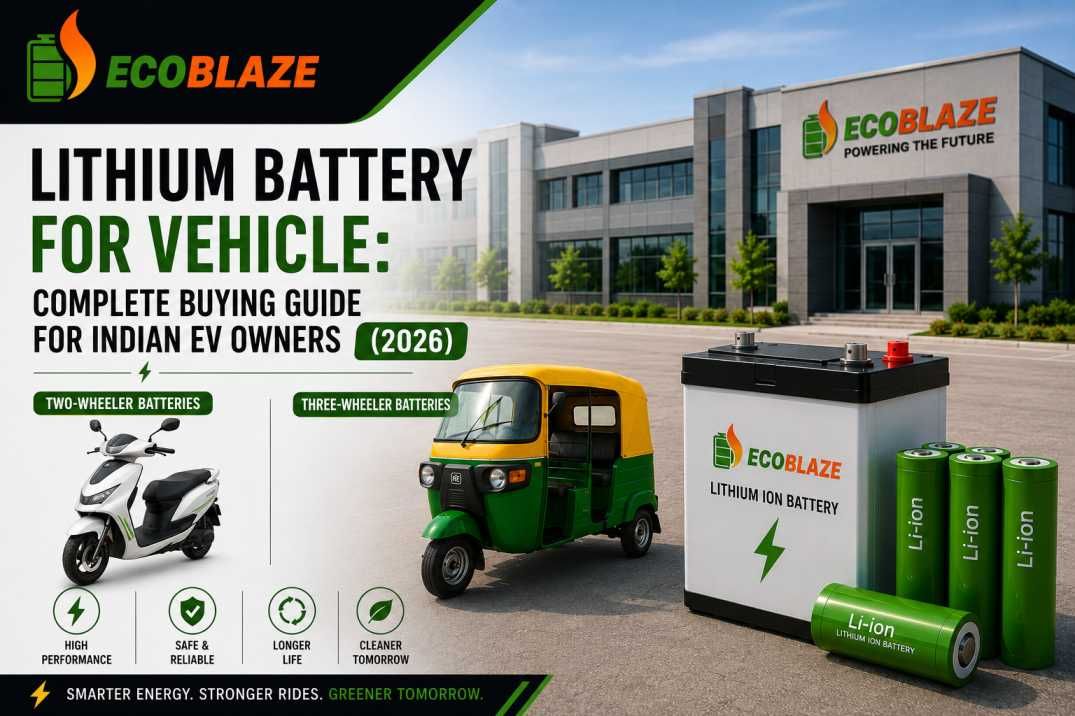
Whether you’re running a personal electric scooter, a commercial e-rickshaw, or a light electric loader, the battery in your vehicle is doing the hardest job on the road. It stores the energy and delivers the power, and its condition determines everything from your range to your repair bills.
Choosing the right lithium battery for vehicle use isn’t complicated once you know what to look for—but with dozens of options in the Indian market and a lot of marketing language flying around, it helps to have a clear framework before you spend money.
This guide breaks down everything you need to know about picking a lithium battery for vehicle applications in India — covering two-wheelers, three-wheelers, and commercial EVs.
Why Lithium Has Become the Standard EV Battery in India
Not long ago, most electric vehicles in India ran on lead-acid batteries. They were cheap, widely available, and familiar. But they came with real limitations that compound fast in daily commercial use.
A standard lead-acid pack lasts 300-500 cycles—roughly 8-12 months of regular use. Charging takes 8-10 hours. The pack is heavy, needs regular maintenance, and gives you no visibility into its health until it fails.
A lithium battery for vehicle use changes all of these factors. Depending on the chemistry—LFP for three-wheelers, NMC for two-wheelers—you’re looking at 1,000 to 2,500+ cycles, 3-4 hour charging, no maintenance, and a smart BMS that monitors the pack in real time. The upfront cost is higher, but the total cost of ownership over 3-5 years almost always favors lithium.
This is why the shift is happening across every EV segment — from personal scooters to commercial e-rickshaw fleets. The economics make sense at scale, and the performance difference is real from day one.
Two Types of Lithium Batteries for Vehicle Use: NMC vs LFP
Before looking at specs, it’s worth understanding that not all lithium batteries are the same chemistry—and chemistry determines almost everything about performance, cycle life, and suitability.
NMC (Nickel Manganese Cobalt)
NMC is the chemistry of choice for a lithium battery for vehicle use in the two-wheeler segment. Key characteristics:
- Higher energy density — more range from a lighter, smaller pack
- 1,000+ cycle life — roughly 3-4 years of daily personal use
- Faster discharge—handles the power demands of scooter and e-bike motors well
- Lighter weight — critical for two-wheelers where every kilogram affects range
If you’re fitting a lithium battery for vehicle use in an electric scooter or e-bike, NMC is the right choice. Our guide on two-wheeler batteries covers this in detail.
LFP (Lithium Iron Phosphate)
LFP is the chemistry of choice for a lithium battery for vehicle use in three-wheelers and commercial applications. Key characteristics:
- 2,500+ cycle life — 5-7 years of heavy daily commercial use
- Better thermal stability — handles Indian summer heat more safely than NMC
- Chemically more stable — lower risk in enclosed vehicle compartments
- Slightly lower energy density — heavier per kWh than NMC, but still much lighter than lead-acid
For e-rickshaws, electric loaders, and commercial three-wheelers, LFP is the best choice. Our guide on three-wheeler batteries covers the full specification range.
What to Check When Buying a Lithium Battery for Vehicle Use
1. Match Your Voltage
This is the first thing to check. Different vehicles use different system voltages — most commonly 48V, 51.2V, 60V, or 72V. The lithium battery for vehicle use must match your motor controller’s voltage exactly. A mismatch doesn’t just underperform—it can damage the controller or the battery pack.
Check your existing battery’s label or your vehicle documentation before ordering.
2. Choose the Right Capacity
Capacity (Ah) determines your range per charge. Higher capacity means more range but also more weight and cost. Match your capacity requirement to your actual daily distance, not the maximum available.
- Two-wheelers: 20–30Ah at 60V covers most urban daily commutes
- Three-wheelers / commercial vehicles: 60–150Ah at 51.2V–72V depending on route length and load
Talk to the manufacturer about your specific requirements—they should be able to recommend the right capacity for your use pattern.
3. IP Rating
Indian road conditions demand proper weather protection. For a lithium battery for vehicle use:
- IP65 minimum for two-wheelers — fully dust-tight and protected against water jets
- IP67 for three-wheelers and commercial vehicles — protected against temporary submersion, essential for monsoon season
Any lithium battery for vehicle use without a verified IP rating is a risk in Indian conditions, regardless of how good the cells inside are.
4. Smart BMS
The Battery Management System is what keeps your lithium battery for vehicle use safe and extends its working life. A proper BMS handles:
- Overcharge and over-discharge protection
- Short circuit and over-current protection
- Thermal cut-off if the pack overheats
- Cell-level voltage monitoring and balancing
For commercial fleet operators, an IoT-enabled BMS adds remote monitoring, fault logging, and location tracking — all of which reduce unexpected downtime. A well-engineered battery management system is as important as the cells themselves.
5. Cycle Life
For a personal vehicle: look for 1,000+ cycles (NMC). For a commercial vehicle: look for 2,500+ cycles (LFP).
Cycle life is the most significant factor in the total cost of ownership. A pack with strong cycle life pays back the price difference over lead-acid and keeps running long after a cheaper pack needs replacing.
6. AIS 156 Certification
Mandatory for any lithium battery used in a registered electric vehicle in India. AIS 156 confirms the pack has passed thermal, mechanical, and electrical safety tests covering overcharge, short circuit, thermal runaway, and water/dust ingress. Check the certifications and compliance page for what this standard covers. Always verify certification documentation before buying—not just a seller’s claim.
7. Charging Time and Charger Compatibility
A quality lithium battery for vehicle use should reach full charge in 3-4 hours for commercial vehicles and around 3 hours for two-wheelers with the recommended charger. Always use a lithium-compatible charger—your existing lead-acid charger will not work correctly with a lithium pack and can damage the BMS permanently.
Lithium Battery for Vehicle vs Lead-Acid: Full Comparison
| Factor | Lead-Acid | Lithium (NMC/LFP) |
|---|---|---|
| Cycle Life | 300–500 | 1,000–2,500+ |
| Lifespan | 8–12 months | 3–7 years |
| Charge Time | 8–10 hours | 3–4 hours |
| Weight | Heavy | Faster than Lead-Acid |
| Maintenance | Regular water topping | None |
| IP Rating | Rarely rated | IP65/IP67 |
| Smart Monitoring | No | Yes (IoT BMS) |
| Upfront Cost | Lower | Higher |
| 5-Year Total Cost | Much higher | Lower |
The cost comparison is where the decision becomes clear for most operators. Replacing lead-acid batteries 4-5 times over 5 years costs significantly more than a single quality lithium battery for vehicle use. Add in charging time savings, range improvement from a lighter pack, and zero maintenance expenses, and lithium wins at total cost every time.
For a detailed financial breakdown with actual numbers, the lithium vs lead acid e-rickshaw cost comparison is worth reading before you make a final decision.
Choosing a Lithium Battery for Vehicle: By Application
Electric Scooters and E-Bikes
For two-wheelers, pick an NMC 21700 pack matched to your scooter’s voltage, with an IP65 rating, 1,000+ cycle life, and AIS 156 certification. Weight matters here — a lighter pack means better range and handling. Our detailed guide on electric bike lithium battery options covers everything specific to this segment.
E-Rickshaws and Electric Autos
For three-wheelers, LFP is the right chemistry. Look for 51.2V or 60V/72V options with an IP67 rating, 2,500+ cycles, a smart BMS with IoT, and AIS 156 certification. The lithium ebike battery guide has more context on how cell chemistry affects real-world range in two-wheeler applications—the same principles apply here in reverse, explaining why LFP is the commercial vehicle choice.
Electric Loaders and Light Commercial Vehicles
Same LFP chemistry as e-rickshaws, but with higher capacity requirements depending on load and distance. Talk to your manufacturer about the Ah requirements based on your daily distance and average load weight; oversizing the capacity wastes money and adds unnecessary weight.
How to Extend the Life of Your Vehicle’s Lithium Battery
Good news — a lithium battery for vehicle use needs very little attention compared to lead-acid. Following the right maintenance tips makes a real difference over the years:
- Use only the lithium-compatible charger recommended by your manufacturer
- Charge after each shift rather than running the pack to empty repeatedly
- Avoid storing the vehicle in direct sun for hours during peak summer
- Report unexpected range drops to your supplier early—the BMS usually logs fault data
- Let the BMS handle cell balancing automatically—no manual intervention needed
Questions to Ask Your Supplier Before Buying
Before committing to any lithium battery for vehicle use, these are the questions worth asking in writing:
- What is the Wh/kg energy density of this pack?
- What cell grade and brand are the cells inside?
- What is the guaranteed cycle life and under what test conditions?
- Is the BMS designed in-house or is it a third-party unit?
- What is the warranty coverage and what does it exclude?
- Could you please provide the AIS 156 certification documentation?
A manufacturer confident in their product answers all of these without hesitation. Evasive or vague answers to any of these questions are a signal worth taking seriously before you commit.
For a broader look at how lithium ion battery companies in India differ in manufacturing capability and reliability, that guide is a useful starting point when comparing suppliers.
FAQs: Lithium Battery for Vehicle
- Which lithium battery is best for a two-wheeler vehicle?
NMC 21700 cells with an IP65 rating, 1,000+ cycle life, and AIS 156 certification are the current standard for two-wheelers. Match the voltage to your motor controller — commonly 48V, 60V, or 72V. - Which lithium battery is best for a three-wheeler commercial vehicle?
LFP chemistry at 51.2V, 60V, or 72V with an IP67 rating, 2,500+ cycle life, and a smart IoT-enabled BMS is the right choice for e-rickshaws and electric loaders in commercial daily use. - How long does a lithium battery last in a vehicle?
NMC packs last 3-4 years (1,000+ cycles) in two-wheelers. LFP packs last 5-7 years (2,500+ cycles) in three-wheelers and commercial vehicles, compared to 8-12 months for lead-acid in either application. - Can I replace my vehicle’s lead-acid battery with lithium?
Yes, in most cases. Confirm voltage compatibility, ensure dimensions fit the battery compartment, and use a lithium-specific charger. The pack will be lighter and charge significantly faster. - Is a lithium battery safe for vehicle use in Indian heat?
Yes. LFP packs are specifically chosen for hot-climate commercial use due to their thermal stability. NMC packs with proper BMS thermal protection also handle Indian summers safely. Both require the BMS to manage thermal cutoff if temperatures exceed safe limits. - How do I know if a lithium battery for vehicle use is AIS 156 certified?
Ask the supplier for the certification document and verify it against the product you’re buying. The certificate should name the specific model and pack configuration, not just the brand.
Conclusion
Choosing the right lithium battery for vehicle use means matching chemistry and specs to your application: NMC for two-wheelers, where range and weight matter; LFP for three-wheelers and commercial vehicles, where cycle life and thermal durability are the priority.
Get the voltage right; insist on IP65 or IP67 depending on your vehicle type; verify AIS 156 certification; and choose a manufacturer with in-house BMS capability. Do that and you’re looking at years of reliable, low-maintenance operation instead of annual battery replacement cycles.
If you’re ready to find the right pack for your vehicle, request a quote from Ecoblaze with your vehicle type, voltage, daily distance, and load requirements—and get a recommendation built specifically around your use case.