Choosing between lead acid vs lithium ion comes down to one question: what does your application actually demand?
Lead acid batteries have powered vehicles and backup systems for over 150 years. Lithium-ion arrived later, costs more upfront, and has steadily taken over every segment it entered—from electric vehicles to solar storage to UPS systems.
This lead-acid vs lithium-ion comparison covers both technologies honestly across every factor that matters when you’re spending real money: cycle life, cost over time, weight, charging behavior, safety, and which application each chemistry actually suits.
What Is a Lead Acid Battery?
A lead-acid battery stores energy through a chemical reaction between lead plates and sulfuric acid electrolyte. It’s one of the oldest rechargeable battery technologies in the world—invented in 1859 and still widely used today because of its low manufacturing cost and broad availability.
Key characteristics:
- Nominal cell voltage: 2V per cell (12V in a standard 6-cell configuration)
- Energy density: 30–50 Wh/kg
- Cycle life: 300–500 cycles
- Charging time: 8–14 hours
- Operating temperature: -20°C to 50°C
- Maintenance: Requires regular water topping (flooded type)
Lead-acid batteries come in several variants—flooded, AGM (Absorbent Glass Mat), and gel—each with slightly different characteristics, but all sharing the same fundamental chemistry and limitations.
What Is a Lithium Ion Battery?
A lithium ion battery stores energy by moving lithium ions between a cathode and anode through an electrolyte. The term covers several distinct chemistries—most commonly NMC (Nickel Manganese Cobalt) and LFP (Lithium Iron Phosphate)—each optimized for different applications.
Key characteristics:
- Nominal cell voltage: 3.2V–3.7V depending on chemistry
- Energy density: 150–250 Wh/kg
- Cycle life: 800–3,000+ cycles depending on chemistry
- Charging time: 1–4 hours
- Operating temperature: -20°C to 60°C
- Maintenance: None
For electric vehicles specifically, two chemistries dominate:
- NMC—higher energy density, ideal for two wheeler batteries where weight matters most
- LFP — longer cycle life and better thermal stability, ideal for three wheeler batteries and commercial vehicles
Lead Acid vs Lithium Ion: Full Comparison
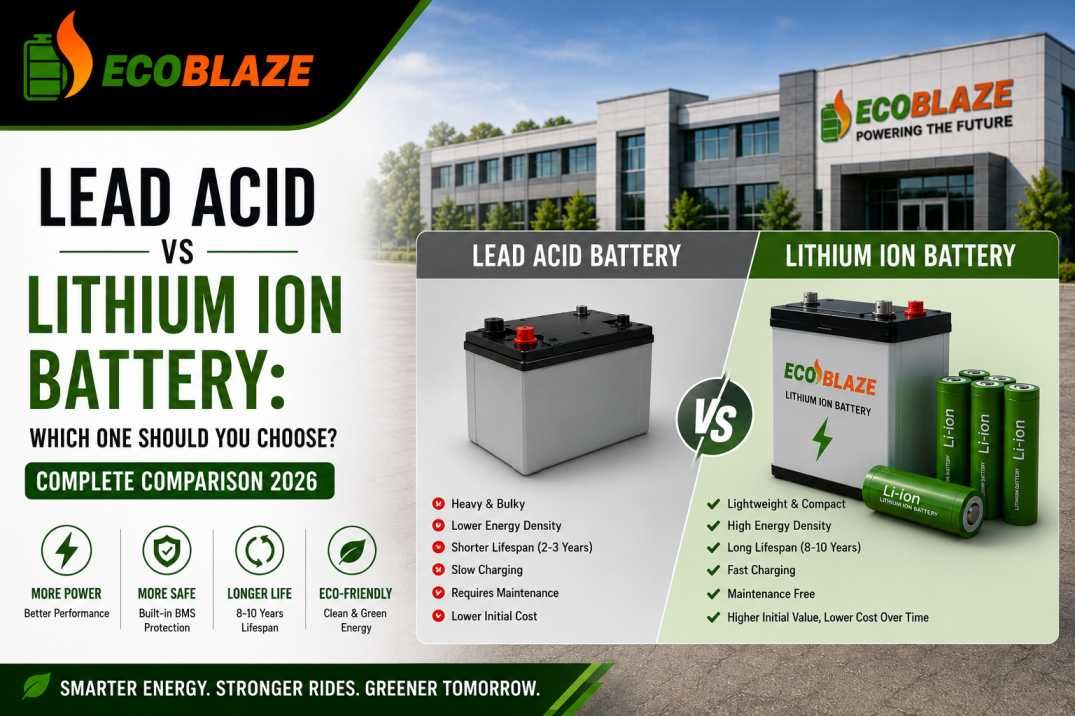
| Factor | Lead Acid | Lithium Ion (NMC/LFP) |
|---|---|---|
| Energy Density | 30–50 Wh/kg | 150–250 Wh/kg |
| Cycle Life | 300–500 cycles | 800–3,000+ cycles |
| Lifespan | 1–2 years (daily use) | 3–7 years |
| Charge Time | 8–14 hours | Faster than Lead Acid |
| Weight | Heavy | 40–60% lighter |
| Self-Discharge | 5–15% per month | 1–3% per month |
| Maintenance | Regular (flooded type) | None |
| IP Rating | Rarely rated | IP65/IP67 available |
| Smart BMS | No | Yes |
| Upfront Cost | Low | High |
| Long-Term Cost | High (frequent replacement) | Low |
| Temperature Range | -20°C to 50°C | -20°C to 60°C |
| Depth of Discharge | 50% recommended | 80–90% usable |
| Safety Risk | Hydrogen gas, acid spill | Low (especially LFP) |
| Recyclability | High (95%+ recycled) | Improving |
Cycle Life and Lifespan: Where the Real Cost Difference Is
This is where the lead-acid vs. lithium-ion comparison becomes most important for anyone doing the math on total cost of ownership.
A lead acid battery rated for 500 cycles at 50% depth of discharge will start showing significant capacity loss after about 400 real-world cycles. In daily commercial use—an e-rickshaw doing two full charges per day—that’s roughly 6-8 months before the pack needs replacing.
An LFP lithium ion battery rated for 2,500 cycles at 80% depth of discharge in the same use case lasts 5-7 years. Over that period, you’d replace lead acid 6-8 times to match that lifespan.
Even at 2-3x the upfront cost, the math strongly favors lithium-ion in any high-cycle application. Our detailed lithium vs lead acid e-rickshaw cost breakdown shows the actual payback calculation for commercial three-wheeler use—typically 12-18 months.
Weight and Energy Density: Why It Matters for EVs
Lead acid batteries store 30-50 Wh per kilogram. Lithium-ion stores 150-250 Wh per kilogram—roughly 4-5x more energy for the same weight.
For an electric vehicle, this isn’t just a performance spec. It’s a range spec.
A 60V/30Ah lead-acid pack weighs approximately 45-50 kg. An equivalent lithium ion pack delivering the same usable energy weighs 15-18 kg — a difference that directly reduces the load on the motor, improves range, and reduces chassis wear over time.
For electric bike lithium battery applications where every kilogram affects range and handling, this gap is decisive. The same principle applies to lithium ebike battery packs, where a lighter battery translates directly into more kilometers per charge.
Charging Behaviour: Lead Acid vs Lithium Ion Speed
Lead acid batteries charge slowly by necessity. Charging too fast damages the plates and shortens cycle life. A full charge typically takes 8-14 hours, and the last 20-30% must be charged at a reduced rate to avoid damage.
Lithium ion charges completely differently. A quality lithium battery for vehicle use reaches 80% charge in 1-2 hours and 100% in 3-4 hours, without the slow finishing phase that lead-acid requires. This matters enormously for commercial operators—a vehicle charging during a lunch break instead of overnight doubles the flexibility of fleet operations.
Safety: Understanding the Real Risks in Lead Acid vs Lithium Ion
Lead-acid batteries produce hydrogen gas during charging—a flammable gas that requires ventilation in enclosed spaces. Flooded variants can also spill acid if the casing is damaged. These aren’t theoretical risks: lead acid fires and battery room incidents happen regularly in poorly maintained setups.
Lithium ion batteries, particularly LFP chemistry, are chemically stable and don’t produce flammable gas during normal operation. They do carry a thermal runaway risk if damaged, overcharged, or manufactured poorly — which is precisely why a well-designed battery management system and AIS 156 certification matter so much for EV applications in India.
A lithium ion battery with a proper BMS and certified construction is safer in a vehicle environment than a lead acid battery without equivalent safety infrastructure.
Depth of Discharge: Lead Acid vs Lithium Ion Usable Capacity
Lead acid batteries should only be discharged to 50% of rated capacity in regular use. Deeper discharge accelerates plate sulfation and dramatically reduces cycle life. This means a 100Ah lead acid battery delivers only 50Ah of usable energy in practice.
Lithium-ion batteries can be safely discharged to 80-90% of their rated capacity without affecting cycle life. A 100Ah lithium pack delivers 80-90Ah of usable energy—nearly double the effective capacity of the same-rated lead acid pack.
This depth of discharge advantage means you need less total capacity from a lithium battery to achieve the same real-world range. It compounds the already significant energy density advantage.
Lead Acid vs Lithium Ion: Temperature Performance in Indian Conditions
India’s climate puts batteries under serious stress — temperatures regularly hit 40-45°C in summer, and some regions go higher. How each chemistry handles sustained heat is a real-world differentiator.
Lead acid batteries lose efficiency significantly above 40°C and degrade faster at elevated temperatures. Water loss in flooded types accelerates in heat, requiring more frequent topping.
LFP lithium ion batteries handle sustained heat better than lead acid and much better than NMC. With a BMS providing thermal cut-off protection, an LFP pack in a commercial three-wheeler operates safely through Indian summers without the maintenance headaches of lead acid. Proper maintenance tips — like avoiding prolonged parking in direct sun — can extend lithium pack life even further in hot climates.
When Lead Acid Still Makes Sense
Lithium ion wins on almost every technical metric in the lead-acid vs. lithium-ion debate. But lead acid still makes sense in specific situations:
- Very low cycle applications—a backup UPS used a few times per year doesn’t need lithium’s cycle life advantage
- Tight upfront budget with no long-term planning — where initial capital cost is the only constraint
- Applications where existing infrastructure is built around lead acid — though this is becoming less common
- Short-term use cases — where the asset won’t be in service long enough to benefit from lithium’s lifespan
For any application involving daily cycling—electric vehicles, solar storage, commercial use—lithium ion’s long-term economics make it the smarter choice.
Lead Acid vs Lithium Ion for Specific Applications
Electric Two-Wheelers
Winner: Lithium Ion (NMC) Weight reduction of 40%+ directly improves range. 1,000+ cycle life vs. 300-500 for lead acid. Faster charging enables daily use without planning around charge windows.
Electric Three-Wheelers and E-Rickshaws
Winner: Lithium Ion (LFP) 2,500+ cycles vs. 300-500. 3-4 hour charge vs. 8-10 hours. IoT-enabled BMS for fleet monitoring. Payback in 12-18 months through replacement savings. You can explore lithium ion battery companies in India to compare suppliers for this segment.
Solar Storage
Winner: Lithium Ion (LFP) Higher usable depth of discharge (80-90% vs 50%) means more effective storage from the same rated capacity. Better cycle life matches the 20+ year lifespan of solar panel installations.
UPS and Inverter Backup
Winner: Depends on cycle frequency For daily-cycling grid-tied backup, lithium is better. For infrequent backup use (a few times per year), lead acid’s lower upfront cost may win.
FAQs: Lead Acid vs Lithium Ion
- Is lithium ion always better than lead acid?
For high-cycle applications—EVs, solar storage, and commercial vehicles—yes, lithium ion wins on total cost of ownership, performance, and lifespan. For very low-cycle backup applications with tight upfront budgets, lead acid can still be cost-effective. - How many more cycles does a lithium-ion battery last compared to a lead-acid battery?
Lead acid delivers 300–500 cycles at 50% depth of discharge. LFP lithium delivers 2,500+ cycles at 80% depth of discharge. In equivalent daily use, that’s roughly a 5-8x longer lifespan for lithium. - Is a lithium-ion battery safe compared to lead-acid?
LFP lithium-ion batteries with proper BMS protection and AIS 156 certification are safer in vehicle environments than lead-acid—no hydrogen gas production, no acid spill risk, and no thermal runaway under normal operating conditions. - Can I directly replace a lead-acid battery with a lithium-ion?
In most EV applications, yes — with the correct voltage match and a lithium-compatible charger. Your existing lead acid charger cannot be used with a lithium pack. Confirm voltage compatibility before ordering. - Why does lithium ion charge faster than lead acid?
Lead-acid requires a slow finishing charge to avoid damaging the plates—the last 20-30% must happen slowly. Lithium-ion doesn’t have this limitation and can accept a rapid charge throughout, reaching a full charge in 3-4 hours versus 8-14 hours for lead-acid. - What is the lifespan of lead acid vs. lithium ion in an e-rickshaw?
In daily commercial e-rickshaw use, a lead acid set lasts 8-12 months before performance drops noticeably. An LFP lithium-ion pack lasts 5-7 years under the same conditions—roughly 5-8 replacement cycles avoided.
Conclusion
The lead-acid vs. lithium-ion debate has a clear answer for most applications in 2026: lithium-ion delivers better performance, longer life, faster charging, and lower total cost of ownership in any high-cycle use case.
Lead acid retains a cost advantage upfront and still makes sense in low-cycle backup applications. But for electric vehicles, solar storage, and commercial use where the battery works hard every day, the lead-acid vs. lithium-ion comparison decisively favors lithium in the long run.
If you’re evaluating a lithium battery for your vehicle or fleet, request a quote from Ecoblaze — and get a pack recommendation matched to your voltage, capacity, and daily distance requirements.