If you drive or own an e-rickshaw, the battery is your biggest running cost. So when you weigh lithium vs lead acid e-rickshaw batteries, the real question is not “which battery is cheaper to buy?” It’s “which one costs me less over the next 3 to 5 years, while keeping the rickshaw earning every single day?”
That is where most operators get the math wrong. Lead-acid looks cheaper on the day you buy it. But by the time you have replaced it four or five times, paid for the lost earning hours, and dealt with the dead-of-summer range drop, the picture changes completely.
This guide breaks down the lithium vs. lead-acid e-rickshaw decision in plain terms, with a 5-year cost-of-ownership view, so you can decide where your money actually goes the furthest.
Quick answer
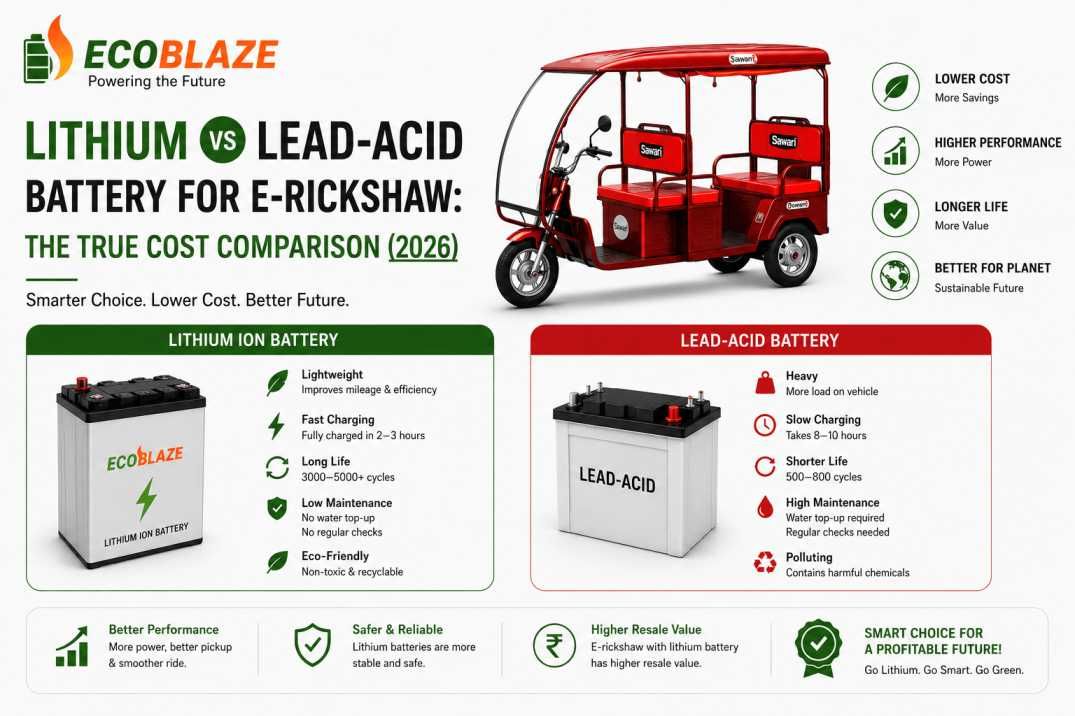
Here is the lithium vs lead acid e-rickshaw decision in one line: for a working e-rickshaw run daily for income, a lithium (LFP) battery almost always costs less over 3 to 5 years, even though it costs more upfront. A good lead-acid set lasts 300 to 500 charge cycles, roughly 12 to 18 months of hard use, and usually needs replacing four to five times in five years. A quality lithium pack lasts 2,500+ cycles, charges in 3 to 4 hours instead of 8 to 10, weighs about 40% less, and typically pays back the extra cost in 12 to 18 months. Lead-acid still makes sense in a few narrow cases, which we’ll be honest about below.
What is a lead-acid battery vs. a lithium battery?
A lead-acid battery is the traditional e-rickshaw battery. Most owners start here because the sticker price is low. Inside, lead plates sit in an acid solution. It works, but it is heavy, slow to charge, and wears out fast when you cycle it deep every day, which is exactly what an e-rickshaw does.
A lithium battery for an e-rickshaw is almost always the LFP type (lithium iron phosphate, written LiFePO4). LFP is the safe, long-life chemistry built for vehicles that run hard in Indian heat. It holds its voltage steady, takes thousands of charge cycles, and needs no water top-ups or terminal cleaning. The pack is managed by a smart BMS (battery management system) that protects it from overcharging, overheating, and short circuits.
In short, lead-acid is the cheap-to-buy option. Lithium (LFP) is the cheap-to-own option.
Head-to-head comparison
Here is how the two stack up on the things that decide your earnings and your costs.
| Factor | Lead-Acid | Lithium (LFP) |
|---|---|---|
| Cycle life | 300–500 cycles | 2,500+ cycles |
| Usable lifespan | ~12–18 months | 5+ years |
| Weight | Heavy (baseline) | ~40% lighter |
| Charging time | 8–10 hours | Fastest |
| Maintenance | Regular: water top-up, terminal cleaning | Virtually none |
| Range stability | Drops as it ages and discharges | Steady, almost to empty |
| Safety | Acid leaks, gassing risk | Smart BMS, AIS 156 certified, IP67 sealed |
| Upfront cost | Lower | Higher (varies, request a quote) |
| Replacements over 5 years | ~4–5 sets | 1 set |
| Total cost of ownership (5 yr) | Higher | Lower |
The two rows that matter most for your pocket are cycle life and replacements over 5 years. Everything else flows from those.
The 5-year cost-of-ownership: a worked example
Let’s keep this honest. Battery prices change with capacity, voltage, and supplier, so we will not quote a fixed rupee figure. Instead, use your own current lead-acid price as the unit. Call it ₹X for one lead-acid set. (The numbers below are illustrative, to show the shape of the cost, not a quote.)
Lead-acid over 5 years
- You replace the set roughly every 12 to 18 months.
- Over 5 years, that is about 4 to 5 sets, so roughly 4X to 5X spent just on batteries.
- Add the hidden costs: each replacement means a day or two off the road, plus the slow charging (8 to 10 hours) that quietly caps how many trips you do daily.
- The range also drops as the set ages, so the last few months before each replacement are weak earning months.
Lithium (LFP) over 5 years
- You buy one pack. It is designed for 2,500+ cycles, which covers 5+ years of daily charging.
- Higher upfront cost, but with the typical payback of 12 to 18 months, the savings start before year two.
- Faster charging (3 to 4 hours) and steady range mean more trips per day and fewer weak months.
Even if a lithium pack costs noticeably more than ₹X upfront, you are comparing one lithium pack against four or five lead-acid sets over the same five years. That is why the total cost of ownership usually lands in lithium’s favor for a vehicle that earns daily. For exact figures for your model and voltage, request a quote from Ecoblaze.
How charging time affects your daily earnings
This figure is the cost no one prints on the box. An e-rickshaw earns only when it is on the road.
A lead-acid set needs 8 to 10 hours to fully charge. In practice, that means an overnight charge and a vehicle that is parked for most of the night and unavailable if you run low during the day. A lithium pack charges in 3 to 4 hours. You can top up during a lunch break, between shifts, or run a second shift in the evening.
For a single owner-driver, faster charging means a few extra trips a day. For a fleet operator running multiple vehicles, it means each rickshaw spends more hours earning and fewer hours plugged in. Over a month, those recovered hours add up to real money, and they never show up in the upfront price comparison.
The steady range helps here too. A lead-acid battery gives strong range when full and weak range when half-empty or aged, so drivers cut trips short to be safe. A lithium pack holds its range almost to the end, so you plan your day with confidence.
Safety and monsoon performance
Indian roads, dust, and a long monsoon are hard on any battery. This scenario is where build quality matters more than price.
Ecoblaze lithium packs are AIS 156 certified, the Indian government safety standard for EV batteries, so they meet the testing rules for thermal and electrical safety. They carry an IP67 rating, which means the pack is sealed against dust and can handle water exposure, important for flooded streets and open battery boxes in the rains. And every pack runs a smart BMS that monitors cell temperature and voltage, cuts off charging when needed, and protects against short circuits and overcharging.
Lead-acid batteries, by contrast, can leak acid, give off gas while charging, and degrade faster in heat. For a vehicle carrying passengers through monsoon traffic every day, the sealed, certified, BMS-protected option is the safer bet for you and your riders.
When lead-acid might still make sense
We won’t pretend lead-acid is always the wrong choice. There are a few honest cases where it can work:
- Very low daily use. If the rickshaw runs only a short distance a few days a week, the battery cycles slowly and lasts longer, so the upfront saving matters more.
- You are selling the vehicle soon. If you plan to sell within a year, you may not be around to enjoy lithium’s long-term savings.
- Tight cash today. If you simply cannot fund the higher upfront cost right now, lead-acid keeps you running until you can upgrade.
For everyone running a rickshaw hard for daily income, though, the lithium math wins clearly. The more you drive, the faster lithium pays back.
How to switch: it’s a drop-in upgrade
Switching is simpler than most owners expect. A quality lithium e-rickshaw battery is built as a drop-in upgrade, made to fit your existing vehicle and connect to your existing motor and controller.
The one thing you must get right is the voltage. E-rickshaws commonly run on 51.2V, 60V, or 72V systems. Your lithium pack must match the voltage your rickshaw is built for. Match the voltage and the right capacity, and the pack fits into the same battery space, with the smart BMS handling the rest.
If you are unsure which voltage your vehicle uses, the simplest step is to check your current battery label or ask the manufacturer. Ecoblaze can confirm the correct fit for your model before you buy.
The bottom line
Lead-acid wins the day you buy it. Lithium wins every year after that. That is the heart of the lithium vs. lead-acid e-rickshaw choice: for a rickshaw that earns its keep daily, a lithium (LFP) pack lasts 2,500+ cycles against 300–500 for lead-acid, charges in a third of the time, weighs about 40% less, and usually pays for itself within 12 to 18 months. Over a 5-year horizon, you are buying one lithium pack instead of four or five lead-acid sets and keeping the rickshaw earning while you do it.
As an AIS 156-certified Indian manufacturer, Ecoblaze builds lithium e-rickshaw batteries with IP67 sealing and a smart BMS, designed and tested for Indian roads and weather.
See the full range on our three-wheeler batteries page, and if you also run two-wheelers, we build our two-wheeler battery range to the same standard. Ready for exact pricing for your voltage and model? Request a quote and we’ll help you pick the right fit.
Frequently asked questions regarding lithium vs lead acid e-rickshaw
Is a lithium battery really cheaper than lead-acid for an e-rickshaw?
Upfront, no, lithium costs more to buy. Over 3 to 5 years, yes, it usually costs less. A lead-acid set lasts 300 to 500 cycles and needs replacing four to five times in five years, while one lithium pack lasts 2,500+ cycles. The typical payback period is 12 to 18 months, after which lithium saves you money.How long does a lithium e-rickshaw battery last?
A quality LFP lithium pack is rated for 2,500+ charge cycles, which works out to roughly 5 years or more of daily use. A lead-acid battery typically lasts 12 to 18 months under the same daily cycling.How long does a lithium e-rickshaw battery take to charge?
About 3 to 4 hours for a full charge, compared with 8 to 10 hours for lead-acid. The faster charge lets you top up between shifts and run more trips in a day.Can I replace my lead-acid battery with a lithium one directly?
Yes. A lithium e-rickshaw battery is a drop-in upgrade that fits your existing vehicle. The key is matching the voltage of your rickshaw, commonly 51.2V, 60V, or 72V. Match the voltage and capacity and the pack fits in the same space.Are lithium e-rickshaw batteries safe in the monsoon?
Yes. Ecoblaze lithium packs are AIS 156 certified, carry an IP67 rating that seals them against dust and water, and use a smart BMS that protects against overheating, overcharging, and short circuits, which makes them well suited to flooded streets and heavy daily use.Does a lithium e-rickshaw battery need any maintenance?
Almost none. There are no water top-ups and no terminal cleaning, which lead-acid batteries require. The pack is sealed and the smart BMS manages it for you. Just keep the connections clean and avoid leaving it fully drained for long periods.Will my old lead-acid charger work with a lithium battery?
No. A lithium pack needs a lithium-specific charger matched to its voltage. Using your old lead-acid charger can damage the battery. Ecoblaze recommends the correct charger for your pack, so confirm the right one at the time of purchase.What does AIS 156 certification mean for an e-rickshaw battery?
AIS 156 is the Indian government safety standard for EV batteries. Certification means the pack has passed the required thermal and electrical safety tests. Choosing an AIS 156 certified battery means it meets the national safety rules, not just a supplier’s word.What does the IP67 rating mean for my battery?
IP67 means the pack is fully sealed against dust and can withstand water exposure. On an e-rickshaw, this is important on dusty roads and during monsoon flooding, when the battery box is likely to become wet.How much range will a lithium e-rickshaw battery give?
Range depends on the pack capacity, your load, the road, and how you drive, so it varies by model. The difference from lead-acid is that a lithium pack holds a steady range almost until empty, instead of fading as it discharges or ages. For the range of a specific capacity and voltage, request a quote from Ecoblaze.Can a lithium battery handle Indian summer heat?
Yes. LFP is a heat-tolerant chemistry, and the smart BMS monitors temperature and cuts charging when needed to protect the cells. The AIS 156 certification also covers thermal safety testing.Is it worth switching if my lead-acid battery still works?
If your rickshaw runs daily for income, usually yes, because every lead-acid replacement costs you money and downtime. If your current set is nearly worn out, switching now will save you from needing to buy another short-life set. If it’s fairly new and you drive very little, you may want to finish its life first.Does a lithium battery weigh less than lead-acid?
Yes, about 40% less. A lighter pack is easier to handle and puts less strain on the vehicle, which helps with range and reduces wear over time.