
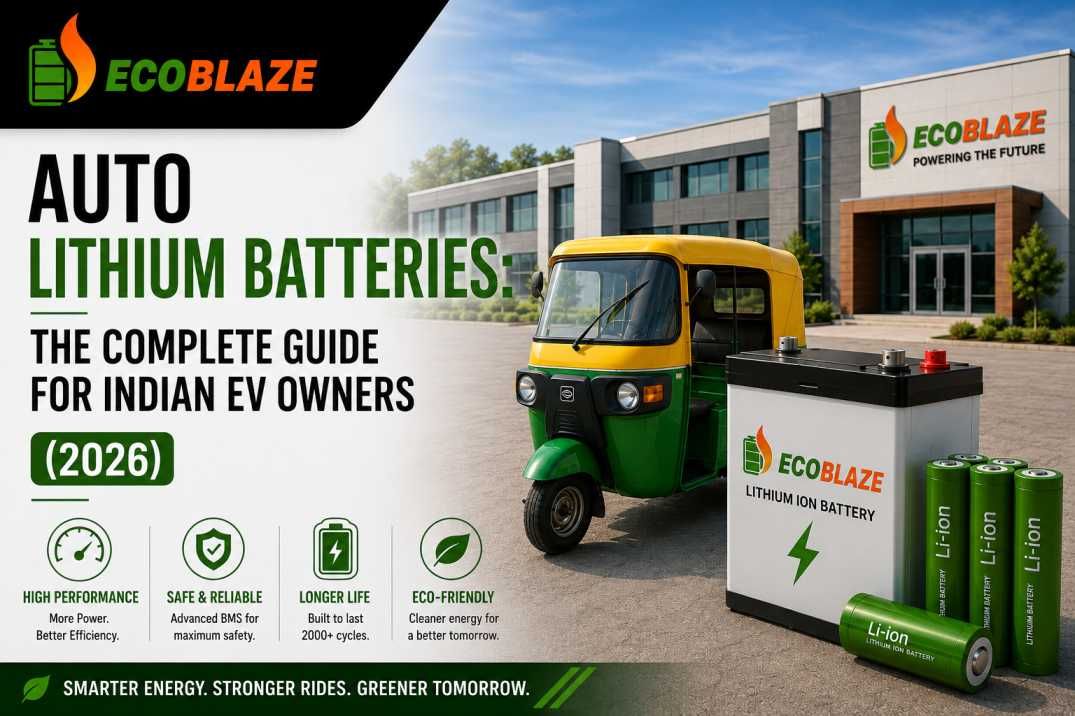
If you operate an electric auto-rickshaw—or any commercial electric vehicle—you already know that your battery is your business. When it’s working well, you’re earning. When it’s not, you’re not.
Auto lithium batteries have changed what’s possible for e-rickshaw operators across India. Faster charging, longer lifespan, less downtime, and lower running costs over time. But with so many options in the market, figuring out what to actually buy and what specs matter can feel overwhelming.
This guide covers everything you need to know about auto lithium batteries—from chemistry and voltage to cycle life and what to watch out for before you part with your money.
What Are Auto Lithium Batteries?
Auto lithium batteries are lithium-ion battery packs designed specifically for electric three-wheelers—e-rickshaws, electric loaders, and electric autos. Unlike the lead-acid batteries that most traditional e-rickshaws still run on, these packs use advanced cell chemistry to deliver more cycles, faster charging, and significantly lower maintenance requirements.
The term “auto” here refers to the auto-rickshaw segment — the backbone of last-mile transport across Indian cities and towns. When people search for auto lithium batteries, they’re typically looking for a lithium battery for vehicle use in the commercial three-wheeler segment, where reliability and running cost per kilometer are the deciding factors.
Why Auto Lithium Batteries Are Replacing Lead-Acid
Walk into any busy e-rickshaw charging hub in North India and you’ll still see rows of vehicles plugged in for 8-10 hours overnight. Most of them are running lead-acid. But that’s changing fast — and for good reason.
Here’s what lead-acid looks like in real commercial use:
- 300–500 charge cycles—roughly 8-12 months before the pack needs replacing
- 8-10 hour charging time — limiting your earning hours if you need a mid-day top-up
- Heavy weight — more strain on the motor and chassis over time
- Regular maintenance — water topping, terminal cleaning, periodic checks
- No smart monitoring — no way to track battery health or predict failure
Auto lithium batteries change this picture completely. A quality LFP lithium battery for vehicle use in the three-wheeler segment delivers the following:
- 2,500+ charge cycles — 5-7 years of daily commercial operation
- 3-4 hour fast charging — charge during lunch and get back on the road
- ~40% lighter than lead-acid equivalents — less motor strain, better efficiency
- Zero maintenance — no water topping, no terminal checks
- Smart BMS with IoT — real-time monitoring of battery health, charge status, and location
Over a 5-year operating period, you’d replace a lead-acid set 5-6 times compared to running a single quality auto lithium battery pack. The math on total cost of ownership almost always favors lithium, even accounting for the higher upfront price.
LFP: The Right Chemistry for Auto Lithium Batteries
Not all lithium chemistries suit commercial auto use equally. For e-rickshaws and electric three-wheelers, LFP (Lithium Iron Phosphate) is the standard—and for good reasons:
Cycle life: LFP cells deliver 2,500+ cycles, far more than the 800-1,200 cycles you’d get from NMC cells. For a vehicle running multiple shifts per day, this factor matters enormously.
Thermal stability: LFP cells handle heat better than NMC, which is critical for Indian summers when ambient temperatures regularly hit 40-45°C. A lithium battery for vehicle use in these conditions needs chemistry that stays stable under sustained thermal load.
Safety: LFP is inherently more stable chemically than higher-energy chemistries, reducing the risk of thermal runaway in an enclosed vehicle compartment.
NMC is the preferred chemistry for two wheeler batteries where energy density and weight matter most. But for heavy commercial use in three wheeler batteries, LFP’s durability and thermal resilience win every time.
Key Specs to Check in Auto Lithium Batteries
Voltage Options
Most e-rickshaws and electric autos operate on 48V, 51.2V, 60V, or 72V systems. The most common LFP configuration for auto lithium batteries is 51.2V — this is the natural LFP equivalent of a traditional 48V lead-acid setup, since LFP cells have a slightly higher nominal voltage per cell than lead-acid.
Always confirm your vehicle’s motor controller voltage before ordering. A mismatch won’t just underperform—it can damage the controller or the battery pack.
Capacity (Ah)
Capacity determines your range per charge. Higher Ah means more distance per charge, but it also adds more weight and cost. For typical urban e-rickshaw routes (60-80 km per day), a 51.2V/100Ah pack is a common choice. For longer routes or heavier loads, step up accordingly.
Talk to your manufacturer about your specific daily distance requirements—they should be able to recommend the right capacity for your route and load pattern.
IP67 Rating
Auto lithium batteries need to handle Indian road conditions — dust, monsoon flooding, road spray, and vibration. IP67 means fully dust-tight and protected against temporary submersion. For a lithium battery for vehicle use in commercial service, anything less than IP67 is a compromise you’ll regret during the first serious monsoon.
Smart BMS with IoT
A capable battery management system keeps your pack safe and long-lasting. It monitors individual cell voltages, balances the pack, and protects against overcharge, over-discharge, short circuit, and thermal events. You can learn more about what a well-designed battery management system covers and why it is relevant for commercial use.
For fleet operators, IoT connectivity in the BMS is especially valuable because it allows remote monitoring of battery health, charge status, and vehicle location, enabling predictive maintenance and reducing unexpected downtime.
Cycle Life
This is the single most important long-term spec for any commercial vehicle pack. Look for a minimum of 2,500 cycles. A pack with excellent cycle life pays back the price difference over lead-acid and keeps earning for years.
AIS 156 Certification
Mandatory for any lithium battery pack used in a registered electric vehicle in India since 2022. AIS 156 certification confirms the pack has passed thermal, mechanical, and electrical safety tests. Full details are on the certifications and compliance page. Never buy auto lithium batteries without verifying this certification is genuine—not just claimed.
Auto Lithium Batteries vs Lead-Acid: Head to Head
| Factor | Lead-Acid | Auto Lithium (LFP) |
|---|---|---|
| Cycle Life | 300–500 | 2,500+ |
| Lifespan | 8–12 months | 5–7 years |
| Charge Time | 8–10 hours | Faster than Lead-Acid |
| Weight | Heavy | ~40% lighter |
| IP Rating | Rarely rated | IP67 available |
| Maintenance | Regular water topping | None |
| Smart Monitoring | No | Yes (IoT BMS) |
| Upfront Cost | Lower | Higher |
| 5-Year Total Cost | Much higher | Lower |
For a detailed financial breakdown of lithium versus lead-acid in three-wheeler commercial use, the lithium vs lead acid e-rickshaw cost comparison covers the numbers in detail—including payback period calculations.
Auto Lithium Batteries for Fleet Operators
If you run a fleet of e-rickshaws or electric autos rather than a single vehicle, the case for switching to lithium gets even stronger.
Fleet-level benefits include:
- Predictable replacement schedule—5-7 year pack life vs replacing lead-acid every year
- Remote monitoring—IoT-enabled BMS lets you track battery health across the entire fleet from a single dashboard
- Faster turnaround — 3-4 hour charging means more operational hours per vehicle per day
- Reduced maintenance overhead — no routine battery servicing across the fleet
- Consistent performance — lithium packs don’t suffer the voltage sag under load that lead-acid shows as it ages
For OEMs and fleet operators looking to standardize on a lithium battery for vehicle use across a mixed fleet, it’s also worth understanding how lithium ion battery companies in India differ in terms of manufacturing capability, certification, and supply reliability before committing to a supplier.
Common Questions Before Buying Auto Lithium Batteries
- Can I fit auto lithium batteries in my existing e-rickshaw?
Yes, in most cases. Auto lithium batteries are designed as drop-in replacements matching standard voltage configurations. The key is confirming your motor controller’s voltage and ensuring the physical dimensions fit your battery compartment. You’ll also need a lithium-compatible charger—your existing lead-acid charger won’t work correctly. - How long do autor lithium batteries take to charge?
A quality LFP pack charges fully in 3-4 hours with the recommended charger—versus 8-10 hours for lead-acid. This makes midday charging practical, increasing your daily earning potential without a long break. - Are auto lithium batteries safe in Indian summer heat?
Yes, when they use LFP chemistry with proper thermal management and a BMS with over-temperature protection. LFP is specifically chosen for commercial vehicle applications in hot climates because of its thermal stability. The BMS cuts power if temperatures exceed safe limits, protecting both the pack and the vehicle. - What happens if the auto lithium battery gets wet?
An IP67-rated pack handles rain, road spray, and temporary flooding without issue. This rating is standard for quality packs designed for Indian road conditions. - How much do auto lithium batteries cost compared to lead-acid?
Upfront, lithium costs more—typically 2-3x the price of a lead-acid set. But over a 5-year period, the total cost, including replacements, usually favors lithium significantly, with payback on the price difference typically within 12-18 months. - Can I use auto-lithium batteries for electric loaders and cargo vehicles too?
Yes. The same LFP chemistry, voltage options, and IP67-rated pack design that works for e-rickshaws is equally suited to electric loaders, cargo autos, and light commercial three-wheelers.
How to Get the Most from Your Auto Lithium Batteries
Lithium packs are low-maintenance by nature, but following the right maintenance tips extends their working life further:
- Use only the lithium-compatible charger supplied or recommended by your manufacturer
- Avoid leaving the pack fully discharged for extended periods—charge after each shift
- Store vehicles in shaded areas where possible during peak summer heat
- Let the smart BMS handle cell balancing — no manual intervention needed
- Report any unusual drops in range to your supplier early—most BMS units log fault codes that a technician can read before a small issue becomes a big one
Conclusion
Auto lithium batteries are the clearest upgrade available to e-rickshaw operators and fleet managers in India right now. Lower running costs, longer life, faster charging, and smart monitoring — the benefits are real and well-documented.
When choosing auto lithium batteries, focus on LFP chemistry, correct voltage matching, IP67 protection, 2,500+ cycle life, smart BMS with IoT, and verified AIS 156 certification. Get those fundamentals right and you’re looking at 5-7 years of reliable commercial operation from a single pack.
If you’re ready to evaluate options for your vehicle or fleet, request a quote from Ecoblaze with your vehicle model, voltage requirement, and daily distance — and get a pack recommendation built around your specific use case.