Electric two-wheelers — scooters, e-bikes, and mopeds — are everywhere on Indian roads now, and for good reason. They’re cheap to run, quick around the city, and genuinely fun once you get used to them. But here’s the thing: the battery is what makes or breaks the whole experience. It decides how far you go, how long it lasts before you’re shopping for a replacement, and how often you’re stuck waiting around for a charge.

So if you’re trying to figure out the best lithium battery for bike use, you’re in the right place. Let’s walk through what actually matters—no jargon overload, just the stuff that’ll help you make a smart choice.


Why Lithium Replaced Lead-Acid for Two-Wheelers

If you’ve ridden an older electric scooter, you probably remember the lead-acid battery days—heavy, slow to charge, and never lasting as long as you’d hoped. A lead-acid pack gives you maybe 300–500 charge cycles and takes a painful 8-10 hours to charge fully. That’s not exactly convenient if you need your bike for the morning commute.

A lithium battery for bike applications — usually NMC chemistry — flips the script completely. You’re looking at 1,000+ cycles, a full charge in around 3 hours, and a pack that weighs roughly 40% less than the lead-acid equivalent. For a two-wheeler, that weight difference isn’t just a number — it directly affects how far you go, how quickly you accelerate, and how the bike feels overall. Modern two wheeler batteries are built around exactly this advantage, which is why switching to a lithium battery for bike use has become such a popular upgrade.


NMC vs. LFP: Which Is Better for Lithium Batteries in Bike Use?

This topic is probably the most common question we get, so let’s settle it. For electric two-wheelers, NMC (Nickel Manganese Cobalt) is generally the better fit, and here’s why:

  • Higher energy density — more range for the same pack size and weight
  • Cycle life of 1,000+ — roughly 3-4 years of daily use
  • Lighter overall pack, improving handling and efficiency

LFP, on the other hand, is more common in three-wheelers and commercial vehicles, where cycle life and thermal stability under heavy daily use matter more than shaving off a kilo or two. But for a personal scooter or e-bike, NMC’s energy density advantage usually wins out.

Cylindrical NMC 21700 cells are the current standard for quality two-wheeler packs — they strike a good balance of energy density, safety, and manufacturing consistency. If a seller can’t tell you whether their pack uses NMC or LFP cells, that’s worth asking twice about before you buy.


What to Check Before Buying a Lithium Battery for Your Bike

1. Voltage Compatibility

Common two-wheeler voltages are 48V, 60V, and 72V. The replacement battery must match your motor controller’s voltage—mismatched voltage can damage the controller or simply not work. If you’re unsure, check your existing battery’s label or the vehicle’s spec sheet.

2. Capacity (Ah) and Range

Capacity determines how far you can ride on a single charge with a lithium battery for bike use. A higher Ah rating means more range but also more weight and cost. Match capacity to your typical daily distance rather than buying the maximum available—carrying unused capacity is wasted weight.

3. IP65 Rating Minimum

Two-wheelers are exposed to rain, road spray, and dust. IP65 means the battery is fully dust-tight and protected against water jets—essential for riding through Indian monsoons without battery failure.

4. Charging Time

Look for packs that reach full charge in around 3 hours with the recommended charger. Faster charging means less time waiting and more time riding, especially useful if you commute daily.

5. Battery Management System (BMS)

A smart battery management system protects against overcharge, over-discharge, overcurrent, short circuit, and overheating, with cell-level voltage monitoring. This is what keeps a lithium pack safe and extends its usable life — don’t compromise here.

6. Weight and Dimensions

If you’re retrofitting an existing vehicle, check that the battery’s physical dimensions fit your battery compartment. A lighter pack also means better range and less strain on the motor.

7. AIS 156 Certification

Mandatory for any lithium battery used in a registered electric vehicle in India. It confirms the pack has passed mechanical, thermal, and electrical safety testing under certifications and compliance standards. Always confirm certification before purchase.


How Much Should a Lithium Battery for Bike Cost?

Pricing varies quite a bit depending on capacity, brand, and chemistry, but here’s a rough way to think about it: a lithium battery for bike use will almost always cost more upfront than a lead-acid pack — sometimes 2-3 times more. That sounds steep until you do the math on replacements.

Remember, a lead-acid battery typically needs replacing every 8-12 months. A good lithium battery for bike applications can run for 3-4 years before you’re thinking about a replacement. So over that same period, you might buy 3-4 lead-acid sets versus just one lithium pack. Add in the fuel/electricity savings from a lighter bike and faster charging, and the lithium option usually wins on total cost — not just performance.

A few things that affect the price you’ll pay:

  • Capacity (Ah): Higher capacity = higher price, but also more range
  • Cell brand and grade: A-grade cells cost more but last longer and perform more consistently
  • BMS quality: A smart BMS with IoT features adds to the cost but pays off in safety and longevity
  • Certification: AIS 156 certified packs may cost slightly more, but skipping this isn’t worth the risk

Don’t just compare sticker prices between brands — compare what’s actually inside the pack.


Lead-Acid vs Lithium Battery for Bike: Comparison

FactorLead-AcidLithium (NMC)
Cycle Life300–500 cycles1,000+ cycles
Lifespan8–12 months3–4 years
Charging Time8–10 hours~Faster than Lead-Acid
WeightHeavy~40% lighter
MaintenanceWater topping requiredNone
Range ImpactLower (weight penalty)Higher (lighter pack)
IP RatingRarely ratedIP65 available

How to Get the Longest Life from Your Lithium Battery for Bike

Good news — keeping a lithium battery for bike use healthy doesn’t take much effort. Following the right maintenance tips can significantly extend its working life:

  • Use only the manufacturer-recommended charger—mismatched chargers stress the BMS
  • Avoid leaving the battery fully discharged for extended periods
  • Store in moderate temperatures (15°C to 35°C) when not in regular use
  • Let the BMS handle cell balancing—no manual maintenance is needed
  • Avoid exposing the pack to direct, prolonged heat (parking in full sun for hours)

That’s really it. No water topping, no acid checks, no periodic servicing. Just sensible charging habits and a bit of care during the summer months.


FAQs: Lithium Battery for Bike

  1. What is the best lithium battery for bike use in India?
    For most electric bikes and scooters, an NMC 21700 cylindrical cell pack with an IP65 rating, 1,000+ cycle life, and AIS 156 certification is the best lithium battery for bike applications currently available.
  2. What is the best lithium battery for an electric bike?
    NMC 21700 cylindrical cell packs are currently the standard for electric bikes and scooters, offering a strong balance of energy density, weight, and cycle life. Look for an IP65 rating, a 1,000+ cycle life, and AIS-156 certification.
  3. How long does a lithium battery last on a bike?
    A quality NMC lithium battery delivers 1,000+ charge cycles, translating to roughly 3 to 4 years of daily use, compared to 8-12 months for lead-acid.
  4. Can I replace my bike’s lead-acid battery with lithium?
    Yes, you can replace your bike’s lead-acid battery with a lithium battery in most cases, provided that the voltage matches your motor controller (commonly 48V, 60V, or 72V) and the physical dimensions fit your battery compartment. Use a lithium-compatible charger — lead-acid chargers are not interchangeable.
  5. How long does it take to charge a lithium bike battery?
    Most quality NMC packs reach full charge in around 3 hours with the recommended charger. Charging time varies based on capacity and charger output rating.
  6. Is NMC or LFP better for an electric bike?
    NMC is generally preferred for two-wheelers due to its higher energy density and lighter weight, which directly improve range. LFP is more common in three-wheelers and commercial vehicles where cycle life matters more than weight.
  7. Do lithium bike batteries need maintenance?
    No. Unlike lead-acid, there’s no water topping or manual upkeep. The smart BMS handles cell balancing automatically — just follow proper charging and storage practices.

Conclusion

Ultimately, choosing a lithium battery for bike use isn’t just about going electric—it’s about getting more range, faster charging, and years of reliable performance without the maintenance headaches that come with lead-acid. The same fundamentals apply across electric mobility, as covered in our guide on lithium vs lead-acid for e-rickshaws.

When you’re picking a lithium battery for bike use, keep it simple: prioritize NMC 21700 cells, the correct voltage match, IP65 rating, 1,000+ cycle life, a smart BMS, and AIS 156 certification. Get those fundamentals right and you won’t need to think about your battery again for years. And if you’re also evaluating suppliers, our roundup of top lithium battery manufacturers in India is a good starting point.


Ready to Upgrade Your Two-Wheeler Battery?

Ecoblaze manufactures AIS 156 certified NMC 21700 lithium battery packs for electric scooters and e-bikes—IP65 rated, ≥1000 cycle life, with smart BMS protection. Built in Ludhiana, we have over 30 years of manufacturing heritage.

Explore 2-Wheeler Batteries | Read: Top Lithium Battery Manufacturers in India | Contact Us
India’s lithium battery industry has grown faster in the last three years than in the previous decade combined. The demand for certified lithium battery packs has never been higher, driven by the adoption of electric vehicles (EVs), government subsidies under FAME II and PM E-DRIVE, and falling cell costs.

But with dozens of brands claiming to manufacture lithium batteries, it’s difficult to separate actual manufacturers from assemblers and importers rebranding Chinese packs.

This list covers companies that design, build, or assemble lithium-ion battery packs in India — with a focus on EV applications. We’ve ranked them based on certifications, product range, technology capability, and market presence.


What Makes a Good Lithium Battery Manufacturer in India?

Before looking at the list, here’s what separates reliable manufacturers from the rest:

  • AIS 156 certification — mandatory for EV battery packs sold in India since 2022
  • In-house BMS design—companies that buy off-the-shelf BMS units have less control over safety and performance
  • Cell sourcing transparency—grade-A cells from verified suppliers vs ungraded imports
  • IP rating—IP65 minimum for two-wheelers and IP67 for three-wheelers and commercial use
  • Cycle life claims backed by test data—LFP should deliver 2,000+ cycles; NMC should deliver 800+

With those criteria in mind, here are the top 10 lithium battery manufacturers in India for 2026.


Top 10 Lithium Battery Manufacturers in India (2026)

1. Ecoblaze (Micron Green Energy) — Ludhiana, Punjab

Ecoblaze, the EV battery brand of Micron Enterprises, is one of India’s most technically focused lithium battery manufacturers for electric two-wheelers and three-wheelers. Based in Ludhiana, Punjab, the company brings over 30 years of Micron Enterprises‘ manufacturing heritage to its battery packs.

Their two-wheeler pack—the LI-ION 6030 — uses cylindrical NMC 21700 cells, delivers 59.2V nominal voltage, has a 30.1Ah rated capacity, and carries an IP65 rating with ≥1000 cycle life. Their three-wheeler LFP packs come in 51.2V, 60V, and 72V options with IP67 protection, 2,500+ cycle life, and smart BMS with IoT and CAN/RS485 communication.

All Ecoblaze battery packs are AIS 156 certified — the mandatory Indian EV battery safety standard.

What sets Ecoblaze apart is their in-house BMS design with integrated IoT connectivity, cell-level voltage monitoring, and multi-layer protection including overcharge, overdischarge, short circuit, and thermal protection. Their packs are built for OEMs, dealers, and commercial fleet operators.

Key specs:

  • Two-wheeler: NMC 21700, 59.2V, IP65, ≥1000 cycles, ~3hr charge
  • Three-wheeler: LFP, 51.2V/60V/72V, IP67, 2500+ cycles, 3–4hr charge
  • Certifications: AIS 156
  • Applications: E-scooters, e-bikes, e-rickshaws, electric loaders

Contact: ecoblaze.in | +91-85007-38000 | Ludhiana, Punjab


2. Exide Industries — Pan-India

One of India’s largest battery companies, with a lithium division covering two-wheelers and stationary storage.

Applications: Two-wheelers, stationary storage, mild hybrid vehicles


3. Amara Raja Energy & Mobility — Tirupati, Andhra Pradesh

Large-scale manufacturer investing in NMC and LFP chemistries, primarily supplying two-wheeler and four-wheeler OEMs.

Applications: Two-wheelers, four-wheelers, energy storage systems


4. Tata AutoComp Systems — Pune, Maharashtra

EV battery systems supplier to Tata Motors, focusing on four-wheeler and commercial vehicle applications.

Applications: Electric cars, buses, commercial vehicles


5. Servotech Power Systems — Delhi

Produces lithium packs for two-wheelers and three-wheelers alongside EV charging infrastructure, with a presence in North India.

Applications: E-rickshaws, two-wheelers, EV charging


6. Epsilon Advanced Materials — Bengaluru, Karnataka

Focused on battery materials and OEM pack supply for EV and industrial applications.

Applications: OEM supply, industrial storage, EV prototypes


7. Nexus Power — Gurugram, Haryana

Manufactures lithium battery packs for electric two-wheelers and light commercial vehicles in North India.

Applications: Two-wheelers, light EVs


8. Maxvolt Energy Industries — Noida, Uttar Pradesh

Dedicated EV and solar lithium battery manufacturer with multiple voltage options for the e-rickshaw and light EV segment.

Applications: E-rickshaws, solar storage, two-wheelers


9. Aqueouss — Delhi

Specialist in lithium battery packs for e-rickshaws and electric three-wheelers, focused on last-mile commercial transport.

Applications: E-rickshaws, electric three-wheelers


10. Greenfuel Energy Solutions — Pune, Maharashtra

Produces LFP and NMC battery packs for two-wheelers, three-wheelers, and solar storage applications.

Applications: Two-wheelers, three-wheelers, solar storage


Lithium Battery Manufacturers in India — Comparison Table

ManufacturerLocationChemistryKey ApplicationAIS 156
Ecoblaze (Micron Green Energy)Ludhiana, PunjabNMC + LFP2W + 3W EV✅ Yes
Exide IndustriesPan-IndiaLFP/NMC2W + StorageYes
Amara Raja EnergyTirupati, APNMC + LFP2W + 4WYes
Tata AutoCompPune, MHNMC4W + CommercialYes
ServotechDelhiLFP2W + 3WYes
Epsilon Advanced MaterialsBengaluru, KAVariousOEM + IndustrialVaries
Nexus PowerGurugram, HRLFP/NMC2W + Light EVYes
Maxvolt EnergyNoida, UPLFP3W + SolarYes
AqueousDelhiLFPE-RickshawYes
Greenfuel EnergyPune, MHLFP/NMC2W + 3WYes

LFP vs NMC: Which Chemistry Should You Choose?

India’s EV battery market primarily uses two lithium chemistries:

LFP (Lithium Iron Phosphate)

  • Cycle life: 2,000–3,000+ cycles
  • Safer at high temperatures—ideal for Indian climate
  • Slightly lower energy density
  • Best for: e-rickshaws, commercial three-wheelers, high-usage applications

NMC (Nickel Manganese Cobalt)

  • Cycle life: 800–1,200 cycles
  • Higher energy density — lighter packs for the same range
  • Best for: electric scooters, e-bikes, performance two-wheelers

For daily commercial use like e-rickshaws, LFP is the stronger choice. For lightweight two-wheelers where range per kg matters, NMC 21700 cylindrical cells deliver better results.


Why AIS 156 Certification Matters

AIS 156 is the mandatory Indian standard for lithium-ion battery packs used in electric vehicles. It covers:

  • Mechanical abuse tests (vibration, shock, crush)
  • Thermal runaway propagation
  • Electrical safety (overcharge, short circuit, over-discharge)
  • Water and dust ingress (IP rating)

Any lithium battery pack sold for use in an Indian EV must carry AIS 156 certification. Buying a non-certified pack voids your vehicle warranty and creates serious liability in case of fire or failure. Always verify certification before purchasing.


How to Choose the Right Lithium Battery Manufacturer in India

  1. For e-rickshaw operators: Prioritize LFP chemistry, IP67 rating, 2,500+ cycle life, and fast charge capability. A quality LFP pack should last 5–7 years of daily commercial use.
  2. For two-wheeler OEMs: Look for NMC 21700 cells, IP65 minimum, in-house BMS with cell-level protection, and AIS 156 certification. Evaluate the manufacturer’s ability to customize voltage and capacity.
  3. For fleet operators, IoT-enabled BMS is critical for remote monitoring, predictive maintenance tips, and reducing downtime. Ask specifically about CAN/RS485 communication support.
  4. For dealers and resellers: Choose manufacturers who offer consistent supply, post-sale technical support, and clear warranty terms. Volume pricing should not come at the cost of cell grade.

FAQs: Lithium Battery Manufacturers in India

  1. Which is the best lithium battery manufacturer in India for e-rickshaws?
    Ecoblaze, Servotech, Maxvolt, and Aqueouss are among the top manufacturers focused on e-rickshaw LFP battery packs. Look for IP67 rating, AIS 156 certification, and 2,500+ cycle life when evaluating options.
  2. Is AIS 156 certification mandatory for lithium batteries in India?
    Yes. Since 2022, AIS 156 certification is mandatory for all lithium-ion battery packs used in electric vehicles sold in India. Non-certified packs cannot be legally used in registered EVs.
  3. What is the difference between an assembler and a manufacturer?
    A manufacturer designs the battery pack, sources and tests cells, builds the BMS in-house, and controls the full production process. An assembler imports pre-made cells and BMS units and puts them together without design control. Manufacturers offer better consistency, customization, and accountability.
  4. How long does a lithium battery last in India’s climate?
    A quality LFP battery pack lasts 5–7 years or 2,500+ cycles under normal commercial use. NMC packs last 3–4 years or 1,000+ cycles. Indian summers (40–45°C) require packs with proper thermal management and BMS over-temperature protection.
  5. Can I replace my lead-acid e-rickshaw battery with lithium?
    Yes. Most lithium battery manufacturers offer drop-in replacement packs that match the voltage and form factor of lead-acid sets. The key is matching the voltage (typically 48V or 60V) and ensuring your charger is compatible. A lithium-specific charger is mandatory — lead-acid chargers cannot be used.
  6. Where are most lithium battery manufacturers in India located?
    Major manufacturing hubs are in Delhi NCR, Pune, Bengaluru, Ludhiana (Punjab), and Hyderabad. North India has seen significant growth due to the high concentration of e-rickshaw manufacturers in UP, Delhi, and Punjab.

Conclusion

India’s lithium battery production is maturing fast. The companies on this list represent the serious players — those with certified products, real manufacturing capability, and the technical depth to support OEMs and commercial operators.

For two-wheeler and three-wheeler applications, Ecoblaze stands out for its combination of AIS 156 certification, in-house IoT-enabled BMS, and proven LFP and NMC pack designs built for Indian road and climate conditions.

Whether you’re an OEM searching for a supply partner, a fleet operator upgrading from lead-acid, or a dealer building your EV battery portfolio—the right manufacturer makes the difference between batteries that last and batteries that don’t.


Ready to Switch to Lithium?

Ecoblaze manufactures AIS 156 certified lithium battery packs for electric two-wheelers and three-wheelers. Built in Ludhiana, the company has over 30 years of manufacturing heritage.

Explore 3-Wheeler Batteries | Explore 2-Wheeler Batteries | Contact Us

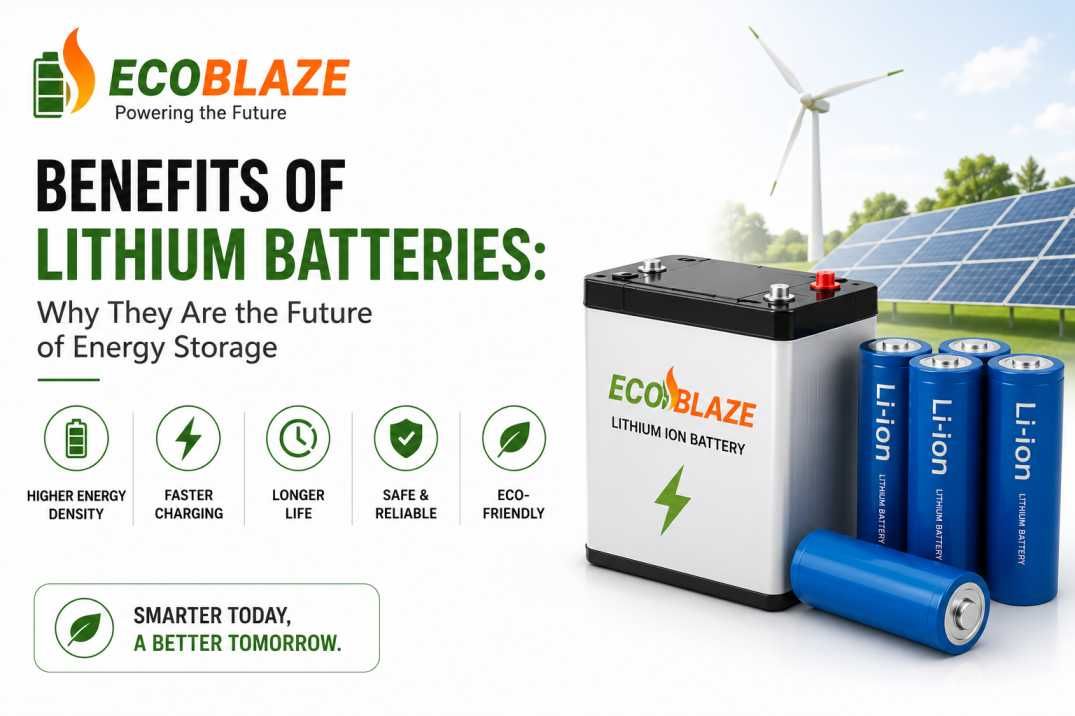
Benefits of Lithium Batteries: Complete Guide to Performance, Lifespan & Efficiency

The benefits of lithium batteries include high energy density, longer lifespan, fast charging, lightweight construction, low maintenance, and superior efficiency compared to traditional lead-acid batteries. Lithium batteries are widely used in electric vehicles, energy storage systems, electric bikes, e-rickshaws, and commercial transportation because they deliver better performance and lower long-term operating costs.

The world is rapidly transitioning toward clean energy and electric mobility. From electric vehicles and solar energy systems to industrial backup solutions, lithium batteries have become the preferred choice for energy storage. Businesses, fleet operators, and consumers are increasingly recognizing the many benefits of lithium batteries, making them one of the most important technologies in the modern energy landscape.

Unlike traditional battery technologies, lithium batteries provide exceptional efficiency, fast charging, a longer lifespan, and lightweight performance. Whether you’re powering an electric scooter, solar power system, or commercial fleet, understanding the benefits of lithium batteries can help you make a smarter investment.

In this comprehensive guide, we explore why lithium batteries are transforming transportation and energy storage while helping businesses reduce costs and improve efficiency.


What Are Lithium Batteries?

Lithium batteries are rechargeable batteries that store and release energy through the movement of lithium ions between positive and negative electrodes.

These batteries are designed to provide the following:

  • High energy density
  • Long cycle life
  • Fast charging capability
  • Lightweight construction
  • Improved safety
  • Better energy efficiency

Because of these advantages, lithium batteries are widely used in electric vehicles, renewable energy systems, consumer electronics, and industrial applications.


Top Benefits of Lithium Batteries

1. High Energy Density

One of the biggest benefits of lithium batteries is their high energy density.

Energy density refers to the amount of energy a battery can store relative to its size and weight.

Advantages include:

  • Longer driving range
  • Compact battery packs
  • Reduced battery weight
  • Better performance

This advantage is one reason why modern electric vehicle battery packs rely heavily on lithium technology.

Compared to conventional batteries, lithium batteries store significantly more power while occupying less space.


2. Longer Lifespan

Another major benefit is longevity.

Most lithium batteries can deliver the following:

  • 2,000–5,000 charging cycles
  • 5–10 years of service life

In contrast, traditional batteries often require replacement much sooner.

This longer lifespan reduces the following:

  • Replacement costs
  • Downtime
  • Maintenance expenses

For commercial applications such as three-wheeler batteries, longer battery life translates into higher profitability and lower operating expenses.


3. Faster Charging Capability

Charging speed is one of the most appreciated benefits of lithium batteries.

Modern lithium batteries support:

  • Rapid charging
  • Reduced charging time
  • Improved operational efficiency

This is especially important for:

  • Electric vehicles
  • Delivery fleets
  • Commercial transportation

A fast-charging battery helps maximize vehicle utilization and reduce downtime.


4. Lightweight Construction

Weight plays a critical role in vehicle performance.

Lithium batteries are substantially lighter than traditional alternatives.

Benefits include:

  • Better acceleration
  • Improved vehicle efficiency
  • Increased payload capacity
  • Better energy utilization

This is why modern two wheeler batteries and Electric Bike Lithium Battery systems rely on lithium technology to improve riding performance and range.

Similarly, a lightweight Lithium Ebike Battery helps riders travel farther without adding excessive weight.


5. Low Maintenance Requirements

Traditional batteries often require the following:

  • Water refilling
  • Frequent inspections
  • Regular maintenance

Lithium batteries eliminate most of these requirements.

This means:

  • Lower maintenance costs
  • Reduced labor
  • Improved convenience

The low-maintenance nature of lithium batteries is one of the key reasons they are becoming the preferred choice across industries.


6. Superior Efficiency

Lithium batteries deliver exceptional energy efficiency.

Benefits include:

  • Better charge retention
  • Lower energy loss
  • Improved charging efficiency
  • Consistent power delivery

This higher efficiency allows users to get more usable energy from every charge cycle.


7. Better Performance in Electric Vehicles

Modern EVs depend heavily on lithium technology.

An advanced Electric Vehicle Lithium Ion Battery provides:

  • Longer range
  • Faster charging
  • Higher efficiency
  • Better reliability

Without lithium batteries, today’s electric mobility revolution would not be possible.

Every high-performance battery pack for electric vehicles relies on lithium chemistry to maximize performance and safety.


Lithium Batteries vs Lead-Acid Batteries

Many buyers compare lithium batteries with traditional lead-acid batteries before making a purchase decision.

FeatureLithium BatteryLead-Acid Battery
Lifespan5–10 Years1–3 Years
Charging SpeedFastSlow
MaintenanceLowHigh
WeightLightweightHeavy
EfficiencyHighModerate
Energy DensityHighLow

For businesses evaluating lithium vs. lead-acid e-rickshaw battery systems, lithium batteries often provide significantly lower ownership costs over the battery’s lifetime.


Applications of Lithium Batteries

Electric Vehicles

One of the largest applications is electric mobility.

Modern Electric Vehicle Lithium Ion Battery technology powers:

  • Electric scooters
  • Electric motorcycles
  • Passenger EVs
  • Commercial vehicles

Lithium batteries help improve vehicle performance while reducing environmental impact.


Electric Bikes

Demand for Electric Bike Lithium Battery solutions continues to grow rapidly.

Benefits include:

  • Better range
  • Lightweight design
  • Faster charging
  • Improved rider experience

Likewise, a high-performance Lithium Ebike Battery provides excellent efficiency for electric bicycles used for commuting and delivery services.


E-Rickshaws

Commercial transportation operators increasingly choose lithium batteries because of their reliability.

A modern Lithium Battery for E-rickshaws offers the following:

  • Faster charging
  • Longer lifespan
  • Reduced maintenance
  • Improved vehicle range

Many operators are replacing traditional batteries with lithium technology to maximize profitability.


Renewable Energy Storage

The following applications widely use lithium batteries:

  • Solar energy systems
  • Residential backup solutions
  • Commercial energy storage
  • Industrial power systems

Their long cycle life makes them ideal for energy storage applications.


Growth of Lithium Battery Technology in India

The Indian EV and renewable energy sectors are growing rapidly.

As a result, many Lithium Ion Battery Companies in India are investing heavily in the following:

  • Battery research
  • Advanced manufacturing
  • Energy storage technology
  • EV battery systems

This innovation is helping accelerate India’s transition toward sustainable transportation and clean energy.


EV Battery Maintenance Tips

Following proper EV battery maintenance tips can significantly improve the lifespan of the battery.

Best practices include:

  • Avoid complete discharge
  • Prevent frequent overcharging
  • Use approved chargers
  • Keep batteries cool
  • Store batteries properly

These simple habits can help maximize performance and battery longevity.


Why Businesses Are Switching to Lithium Batteries

Businesses choose lithium batteries because they offer:

  • Lower Operating Costs: Longer lifespan reduces replacement expenses.
  • Increased Productivity: Fast charging minimizes downtime.
  • Better Reliability: Consistent power delivery improves operations.
  • Improved Sustainability: Lithium batteries support cleaner energy solutions.

These advantages make lithium batteries a smart long-term investment.


Future of Lithium Batteries

The future of lithium technology looks promising.

Emerging innovations include:

  • Solid-state batteries
  • Faster charging systems
  • Improved battery recycling
  • Higher energy density
  • Advanced battery management systems

These developments will further enhance the benefits of lithium batteries over the coming years.


Conclusion

The benefits of lithium batteries make them one of the most important technologies powering today’s energy transition. Their high energy density, long lifespan, fast charging capability, lightweight construction, and low maintenance requirements provide significant advantages over traditional battery systems.

Whether powering two-wheeler batteries, three wheeler batteries, an advanced Electric Bike Lithium Battery, a Lithium Ebike Battery, or a modern electric vehicle battery pack, lithium technology delivers superior performance and long-term value.

Businesses and consumers looking to improve efficiency, reduce costs, and support sustainable transportation should strongly consider lithium battery solutions. If you’re exploring advanced battery options for EVs or energy storage applications, you can request a quote from Ecoblaze to learn more about lithium battery systems designed for modern energy needs.


People Also Ask and FAQs

  1. What are the main benefits of lithium batteries?
    Lithium batteries offer high energy density, fast charging, a long lifespan, lightweight design, and low maintenance.
  2. Why are lithium batteries better than lead-acid batteries?
    They last longer, charge faster, weigh less, and provide better efficiency.
  3. How long do lithium batteries last?
    Most lithium batteries last between 5 and 10 years depending on usage.
  4. Are lithium batteries suitable for electric vehicles?
    Yes, they are the preferred battery technology for modern EVs.
  5. Can lithium batteries be used for solar energy storage?
    Yes, they are widely used in residential and commercial solar systems.
  6. Do lithium batteries require maintenance?
    Very little maintenance is required compared to traditional batteries.
  7. What affects lithium battery lifespan?
    Charging habits, temperature, and battery quality influence lifespan.
  8. Are lithium batteries safe?
    Yes, modern batteries include advanced safety systems and battery management technology.
  9. Can lithium batteries improve EV range?
    Yes, higher energy density helps increase driving range significantly.
  10. Why are lithium batteries becoming so popular?
    They offer superior efficiency, longer lifespan, rapid charging, and lower operating costs.

If you drive or own an e-rickshaw, the battery is your biggest running cost. So when you weigh lithium vs lead acid e-rickshaw batteries, the real question is not “which battery is cheaper to buy?” It’s “which one costs me less over the next 3 to 5 years, while keeping the rickshaw earning every single day?”

That is where most operators get the math wrong. Lead-acid looks cheaper on the day you buy it. But by the time you have replaced it four or five times, paid for the lost earning hours, and dealt with the dead-of-summer range drop, the picture changes completely.

This guide breaks down the lithium vs. lead-acid e-rickshaw decision in plain terms, with a 5-year cost-of-ownership view, so you can decide where your money actually goes the furthest.

Quick answer

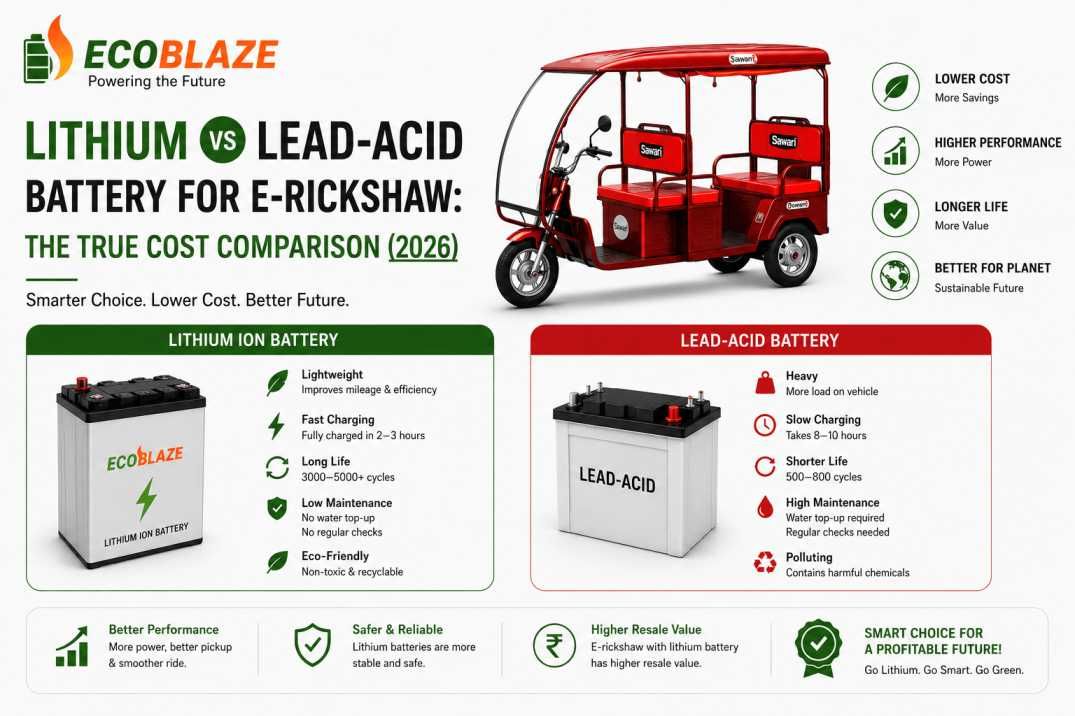
Here is the lithium vs lead acid e-rickshaw decision in one line: for a working e-rickshaw run daily for income, a lithium (LFP) battery almost always costs less over 3 to 5 years, even though it costs more upfront. A good lead-acid set lasts 300 to 500 charge cycles, roughly 12 to 18 months of hard use, and usually needs replacing four to five times in five years. A quality lithium pack lasts 2,500+ cycles, charges in 3 to 4 hours instead of 8 to 10, weighs about 40% less, and typically pays back the extra cost in 12 to 18 months. Lead-acid still makes sense in a few narrow cases, which we’ll be honest about below.

What is a lead-acid battery vs. a lithium battery?

A lead-acid battery is the traditional e-rickshaw battery. Most owners start here because the sticker price is low. Inside, lead plates sit in an acid solution. It works, but it is heavy, slow to charge, and wears out fast when you cycle it deep every day, which is exactly what an e-rickshaw does.

A lithium battery for an e-rickshaw is almost always the LFP type (lithium iron phosphate, written LiFePO4). LFP is the safe, long-life chemistry built for vehicles that run hard in Indian heat. It holds its voltage steady, takes thousands of charge cycles, and needs no water top-ups or terminal cleaning. The pack is managed by a smart BMS (battery management system) that protects it from overcharging, overheating, and short circuits.

In short, lead-acid is the cheap-to-buy option. Lithium (LFP) is the cheap-to-own option.

Head-to-head comparison

Here is how the two stack up on the things that decide your earnings and your costs.

FactorLead-AcidLithium (LFP)
Cycle life300–500 cycles2,500+ cycles
Usable lifespan~12–18 months5+ years
WeightHeavy (baseline)~40% lighter
Charging time8–10 hoursFastest
MaintenanceRegular: water top-up, terminal cleaningVirtually none
Range stabilityDrops as it ages and dischargesSteady, almost to empty
SafetyAcid leaks, gassing riskSmart BMS, AIS 156 certified, IP67 sealed
Upfront costLowerHigher (varies, request a quote)
Replacements over 5 years~4–5 sets1 set
Total cost of ownership (5 yr)HigherLower

The two rows that matter most for your pocket are cycle life and replacements over 5 years. Everything else flows from those.

The 5-year cost-of-ownership: a worked example

Let’s keep this honest. Battery prices change with capacity, voltage, and supplier, so we will not quote a fixed rupee figure. Instead, use your own current lead-acid price as the unit. Call it ₹X for one lead-acid set. (The numbers below are illustrative, to show the shape of the cost, not a quote.)

Lead-acid over 5 years

  • You replace the set roughly every 12 to 18 months.
  • Over 5 years, that is about 4 to 5 sets, so roughly 4X to 5X spent just on batteries.
  • Add the hidden costs: each replacement means a day or two off the road, plus the slow charging (8 to 10 hours) that quietly caps how many trips you do daily.
  • The range also drops as the set ages, so the last few months before each replacement are weak earning months.

Lithium (LFP) over 5 years

  • You buy one pack. It is designed for 2,500+ cycles, which covers 5+ years of daily charging.
  • Higher upfront cost, but with the typical payback of 12 to 18 months, the savings start before year two.
  • Faster charging (3 to 4 hours) and steady range mean more trips per day and fewer weak months.

Even if a lithium pack costs noticeably more than ₹X upfront, you are comparing one lithium pack against four or five lead-acid sets over the same five years. That is why the total cost of ownership usually lands in lithium’s favor for a vehicle that earns daily. For exact figures for your model and voltage, request a quote from Ecoblaze.

How charging time affects your daily earnings

This figure is the cost no one prints on the box. An e-rickshaw earns only when it is on the road.

A lead-acid set needs 8 to 10 hours to fully charge. In practice, that means an overnight charge and a vehicle that is parked for most of the night and unavailable if you run low during the day. A lithium pack charges in 3 to 4 hours. You can top up during a lunch break, between shifts, or run a second shift in the evening.

For a single owner-driver, faster charging means a few extra trips a day. For a fleet operator running multiple vehicles, it means each rickshaw spends more hours earning and fewer hours plugged in. Over a month, those recovered hours add up to real money, and they never show up in the upfront price comparison.

The steady range helps here too. A lead-acid battery gives strong range when full and weak range when half-empty or aged, so drivers cut trips short to be safe. A lithium pack holds its range almost to the end, so you plan your day with confidence.

Safety and monsoon performance

Indian roads, dust, and a long monsoon are hard on any battery. This scenario is where build quality matters more than price.

Ecoblaze lithium packs are AIS 156 certified, the Indian government safety standard for EV batteries, so they meet the testing rules for thermal and electrical safety. They carry an IP67 rating, which means the pack is sealed against dust and can handle water exposure, important for flooded streets and open battery boxes in the rains. And every pack runs a smart BMS that monitors cell temperature and voltage, cuts off charging when needed, and protects against short circuits and overcharging.

Lead-acid batteries, by contrast, can leak acid, give off gas while charging, and degrade faster in heat. For a vehicle carrying passengers through monsoon traffic every day, the sealed, certified, BMS-protected option is the safer bet for you and your riders.

When lead-acid might still make sense

We won’t pretend lead-acid is always the wrong choice. There are a few honest cases where it can work:

  • Very low daily use. If the rickshaw runs only a short distance a few days a week, the battery cycles slowly and lasts longer, so the upfront saving matters more.
  • You are selling the vehicle soon. If you plan to sell within a year, you may not be around to enjoy lithium’s long-term savings.
  • Tight cash today. If you simply cannot fund the higher upfront cost right now, lead-acid keeps you running until you can upgrade.

For everyone running a rickshaw hard for daily income, though, the lithium math wins clearly. The more you drive, the faster lithium pays back.

How to switch: it’s a drop-in upgrade

Switching is simpler than most owners expect. A quality lithium e-rickshaw battery is built as a drop-in upgrade, made to fit your existing vehicle and connect to your existing motor and controller.

The one thing you must get right is the voltage. E-rickshaws commonly run on 51.2V, 60V, or 72V systems. Your lithium pack must match the voltage your rickshaw is built for. Match the voltage and the right capacity, and the pack fits into the same battery space, with the smart BMS handling the rest.

If you are unsure which voltage your vehicle uses, the simplest step is to check your current battery label or ask the manufacturer. Ecoblaze can confirm the correct fit for your model before you buy.

The bottom line

Lead-acid wins the day you buy it. Lithium wins every year after that. That is the heart of the lithium vs. lead-acid e-rickshaw choice: for a rickshaw that earns its keep daily, a lithium (LFP) pack lasts 2,500+ cycles against 300–500 for lead-acid, charges in a third of the time, weighs about 40% less, and usually pays for itself within 12 to 18 months. Over a 5-year horizon, you are buying one lithium pack instead of four or five lead-acid sets and keeping the rickshaw earning while you do it.

As an AIS 156-certified Indian manufacturer, Ecoblaze builds lithium e-rickshaw batteries with IP67 sealing and a smart BMS, designed and tested for Indian roads and weather.

See the full range on our three-wheeler batteries page, and if you also run two-wheelers, we build our two-wheeler battery range to the same standard. Ready for exact pricing for your voltage and model? Request a quote and we’ll help you pick the right fit.

Frequently asked questions regarding lithium vs lead acid e-rickshaw

  1. Is a lithium battery really cheaper than lead-acid for an e-rickshaw?
    Upfront, no, lithium costs more to buy. Over 3 to 5 years, yes, it usually costs less. A lead-acid set lasts 300 to 500 cycles and needs replacing four to five times in five years, while one lithium pack lasts 2,500+ cycles. The typical payback period is 12 to 18 months, after which lithium saves you money.

  2. How long does a lithium e-rickshaw battery last?
    A quality LFP lithium pack is rated for 2,500+ charge cycles, which works out to roughly 5 years or more of daily use. A lead-acid battery typically lasts 12 to 18 months under the same daily cycling.

  3. How long does a lithium e-rickshaw battery take to charge?
    About 3 to 4 hours for a full charge, compared with 8 to 10 hours for lead-acid. The faster charge lets you top up between shifts and run more trips in a day.

  4. Can I replace my lead-acid battery with a lithium one directly?
    Yes. A lithium e-rickshaw battery is a drop-in upgrade that fits your existing vehicle. The key is matching the voltage of your rickshaw, commonly 51.2V, 60V, or 72V. Match the voltage and capacity and the pack fits in the same space.

  5. Are lithium e-rickshaw batteries safe in the monsoon?
    Yes. Ecoblaze lithium packs are AIS 156 certified, carry an IP67 rating that seals them against dust and water, and use a smart BMS that protects against overheating, overcharging, and short circuits, which makes them well suited to flooded streets and heavy daily use.

  6. Does a lithium e-rickshaw battery need any maintenance?
    Almost none. There are no water top-ups and no terminal cleaning, which lead-acid batteries require. The pack is sealed and the smart BMS manages it for you. Just keep the connections clean and avoid leaving it fully drained for long periods.

  7. Will my old lead-acid charger work with a lithium battery?
    No. A lithium pack needs a lithium-specific charger matched to its voltage. Using your old lead-acid charger can damage the battery. Ecoblaze recommends the correct charger for your pack, so confirm the right one at the time of purchase.

  8. What does AIS 156 certification mean for an e-rickshaw battery?
    AIS 156 is the Indian government safety standard for EV batteries. Certification means the pack has passed the required thermal and electrical safety tests. Choosing an AIS 156 certified battery means it meets the national safety rules, not just a supplier’s word.

  9. What does the IP67 rating mean for my battery?
    IP67 means the pack is fully sealed against dust and can withstand water exposure. On an e-rickshaw, this is important on dusty roads and during monsoon flooding, when the battery box is likely to become wet.

  10. How much range will a lithium e-rickshaw battery give?
    Range depends on the pack capacity, your load, the road, and how you drive, so it varies by model. The difference from lead-acid is that a lithium pack holds a steady range almost until empty, instead of fading as it discharges or ages. For the range of a specific capacity and voltage, request a quote from Ecoblaze.

  11. Can a lithium battery handle Indian summer heat?
    Yes. LFP is a heat-tolerant chemistry, and the smart BMS monitors temperature and cuts charging when needed to protect the cells. The AIS 156 certification also covers thermal safety testing.

  12. Is it worth switching if my lead-acid battery still works?
    If your rickshaw runs daily for income, usually yes, because every lead-acid replacement costs you money and downtime. If your current set is nearly worn out, switching now will save you from needing to buy another short-life set. If it’s fairly new and you drive very little, you may want to finish its life first.

  13. Does a lithium battery weigh less than lead-acid?
    Yes, about 40% less. A lighter pack is easier to handle and puts less strain on the vehicle, which helps with range and reduces wear over time.

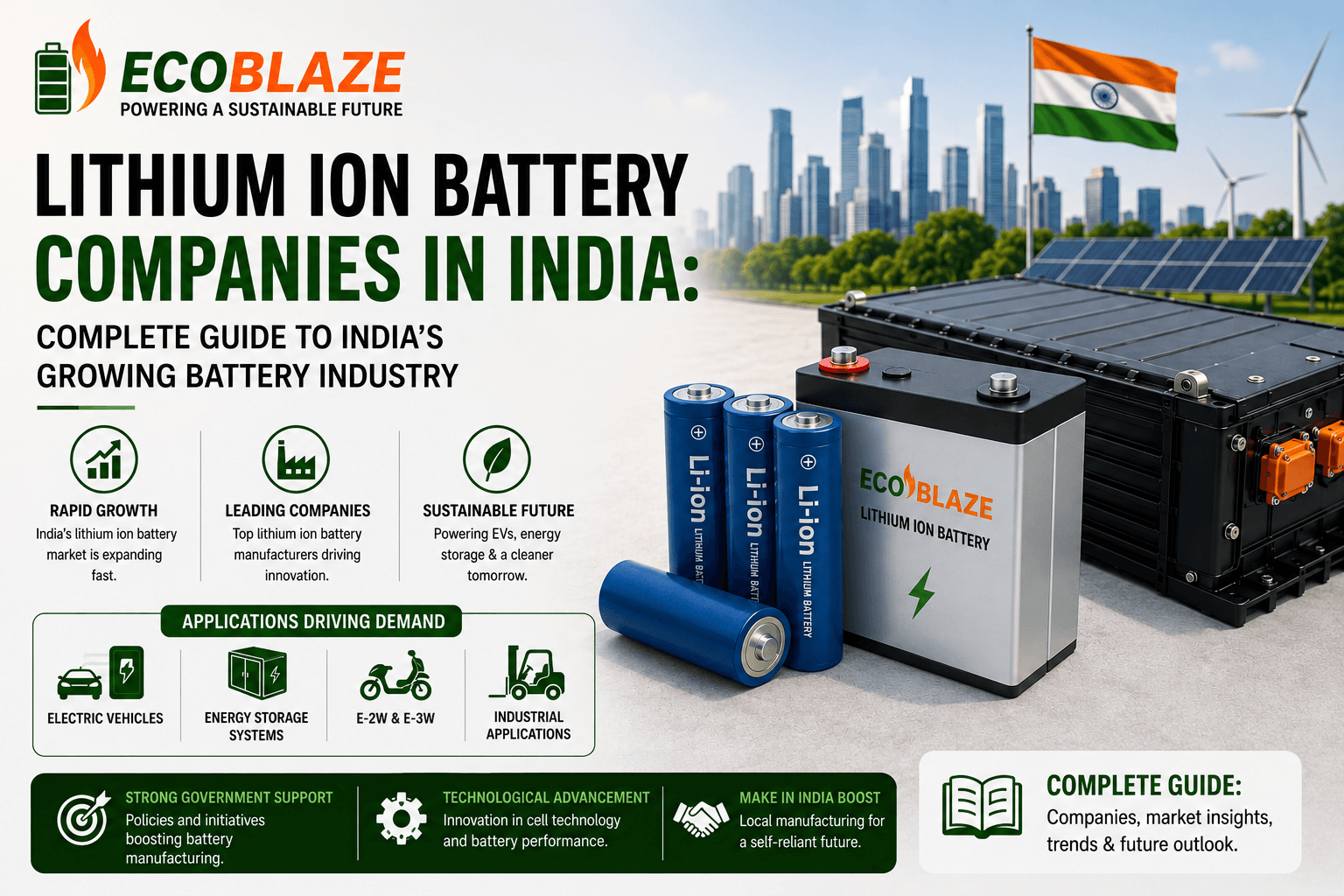
Lithium ion battery companies in India are manufacturers, suppliers, and technology providers that design, develop, and produce lithium ion batteries for electric vehicles, energy storage systems, solar applications, e-rickshaws, electric bikes, and industrial power solutions. These companies focus on advanced battery technology, battery management systems (BMS), high energy density, fast charging, and long battery life to support India’s growing EV and renewable energy sectors.


Introduction of Lithium Ion Battery Companies in India

India is witnessing a massive shift toward electric mobility and renewable energy. As electric vehicles become more common and solar energy adoption increases, the demand for reliable energy storage solutions continues to grow. This rapid transformation has created opportunities for lithium-ion battery companies to play a crucial role in the country’s clean energy future.

Today, lithium-ion battery companies are developing advanced battery technologies that power electric scooters, e-rickshaws, electric bikes, passenger EVs, commercial fleets, and industrial applications. Modern lithium ion batteries offer higher energy density, faster charging, longer lifespan, and improved safety compared to traditional battery technologies.

In this comprehensive guide, we will explore the Indian lithium battery industry, battery technologies, applications, market trends, and how to choose the right battery solutions.


What Are Lithium Ion Battery Companies?

Lithium Ion Battery Companies specialize in designing, manufacturing, assembling, and supplying lithium ion battery systems.

These companies typically provide:

  • EV batteries
  • Energy storage systems
  • Solar storage batteries
  • Industrial battery solutions
  • Battery packs for electric vehicles
  • Custom battery systems

The primary goal of lithium-ion battery companies is to deliver efficient, lightweight, and long-lasting energy storage solutions.


Why Lithium Ion Batteries Are Dominating the Market

The popularity of lithium ion batteries continues to grow because of their numerous advantages.

High Energy Density

Lithium batteries can store more energy while maintaining a compact size.

Benefits include:

  • Longer driving range
  • Lightweight vehicles
  • Better performance

This makes them ideal for electric vehicle lithium-ion battery applications.


Faster Charging Capability

Modern lithium batteries support:

  • Rapid charging
  • Reduced downtime
  • Improved efficiency

Fast charging is especially important for commercial EV operations.


Longer Lifespan

Lithium-ion batteries generally offer the following:

  • 2,000–5,000 charge cycles
  • 5–10-year lifespan

This reduces long-term ownership costs.


Low Maintenance Requirements

Unlike traditional batteries, lithium batteries require the following:

  • No water topping
  • Minimal servicing
  • Lower maintenance costs

These advantages contribute to their growing popularity.


Applications of Lithium Ion Battery Companies in India

Electric Vehicles

The largest market for lithium-ion battery companies is electric mobility.

Applications include:

  • Electric scooters
  • Electric motorcycles
  • Passenger EVs
  • Fleet vehicles

Demand for two-wheeler batteries continues to increase as EV adoption grows.


E-Rickshaws

India’s e-rickshaw market is expanding rapidly.

Advanced lithium battery for e-rickshaw solutions offer:

  • Longer range
  • Faster charging
  • Better reliability

Many operators are replacing lead-acid batteries with lithium technology.


Electric Bikes

Modern electric bike lithium battery systems provide the following:

  • Lightweight construction
  • Better acceleration
  • Increased range

Consumers increasingly prefer lithium batteries for electric bikes.


Energy Storage Systems

Lithium batteries support the following:

  • Residential solar systems
  • Commercial energy storage
  • Backup power applications

This creates additional opportunities for lithium-ion battery companies.


Key Technologies Used by Lithium Ion Battery Companies

Lithium Iron Phosphate (LFP)

LFP batteries provide the following:

  • Excellent safety
  • Longer cycle life
  • Better thermal stability

They are commonly used in:

  • E-rickshaws
  • Electric scooters
  • Commercial EVs

Nickel Manganese Cobalt (NMC)

NMC batteries offer:

  • High energy density
  • Longer range
  • Better performance

These batteries are widely used in premium EV applications.


Smart Battery Management Systems

Modern batteries include advanced BMS technology.

Functions include:

  • Temperature monitoring
  • Voltage balancing
  • Overcharge protection
  • Short-circuit protection

A robust BMS improves battery safety and lifespan.


How Battery Pack for Electric Vehicle Technology Works

A modern battery pack for electric vehicles consists of the following:

Battery Cells

Individual cells store electrical energy.

Common formats include:

  • Cylindrical cells
  • Prismatic cells
  • Pouch cells

Battery Modules

Multiple cells are grouped into modules.

Battery Management System

The BMS controls charging, safety, and battery health.

Thermal Management

Cooling systems maintain safe operating temperatures.

An advanced electric vehicle battery pack ensures high performance and safety.


Choosing the Right Lithium Ion Battery Company

When evaluating lithium-ion battery companies, consider the following factors.

Product Quality

Look for:

  • High-quality cells
  • Reliable BMS
  • Durable construction

Certifications

Ensure compliance with:

  • BIS standards
  • ISO certifications
  • Safety regulations

Technical Support

Reliable manufacturers offer:

  • Warranty coverage
  • Service support
  • Technical assistance

Manufacturing Capability

A reputable lithium battery manufacturer in India should have the following:

  • Modern production facilities
  • Quality control systems
  • Advanced testing procedures

Future of Lithium Ion Battery Companies in India

The future looks promising for lithium-ion battery companies.

Growth drivers include:

  • EV adoption
  • Renewable energy expansion
  • Government incentives
  • Rising fuel costs

Emerging technologies include:

  • Solid-state batteries
  • Faster charging systems
  • Improved energy density
  • Advanced recycling methods

As innovation continues, battery performance will improve significantly.


EV Battery Maintenance Tips

Following proper ev battery maintenance tips helps maximize battery lifespan.

Recommendations include:

  • Avoid overcharging
  • Prevent deep discharge
  • Use approved chargers
  • Maintain moderate temperatures
  • Store batteries properly

Good maintenance improves battery health and reliability.


Conclusion

The rise of Lithium Ion Battery Companies is transforming India’s electric mobility and renewable energy sectors. With advancements in battery technology, energy storage, and manufacturing capabilities, lithium ion batteries are becoming the preferred solution for electric vehicles, solar systems, and industrial applications.

As demand continues to grow, businesses and consumers must focus on choosing reliable battery solutions that offer high performance, safety, and long-term value. The future of India’s clean energy transition will be powered by innovation from leading Lithium Ion Battery Companies.


People Also Ask and FAQs

  1. What are lithium ion battery companies?
    They are businesses that manufacture and supply lithium ion battery systems for EVs, solar storage, and industrial applications.
  2. Why are lithium ion batteries popular?
    Because they offer high energy density, fast charging, and long lifespan.
  3. Which industries use lithium ion batteries?
    Electric vehicles, solar energy, telecom, manufacturing, and backup power systems.
  4. How long do lithium ion batteries last?
    Most batteries last between 5 and 10 years depending on usage and maintenance.
  5. Are lithium ion batteries safe?
    Yes, modern batteries include advanced safety systems and battery management technology.
  6. What is the advantage of lithium batteries over lead-acid batteries?
    Lithium batteries are lighter, charge faster, and last significantly longer.
  7. Can lithium batteries be used for solar energy storage?
    Yes, they are highly efficient for renewable energy applications.
  8. What affects lithium battery lifespan?
    Temperature, charging habits, and battery quality influence lifespan.
  9. Do lithium batteries require maintenance?
    Very little maintenance is required compared to traditional batteries.
  10. What is a battery management system?
    A BMS monitors and protects battery performance, safety, and charging cycles.

Electric Vehicle Battery Pack: Everything You Need to Know Before Choosing One

The electric vehicle battery pack is the most important component inside an electric vehicle. Whether powering scooters, electric bikes, passenger EVs, or commercial vehicles, the vehicle battery pack determines performance, driving range, charging speed, safety, and long-term ownership cost.

As EV adoption rises globally, consumers increasingly search for answers about electric vehicle battery pack technology, battery lifespan, charging cycles, maintenance, and battery chemistry.

In simple terms:

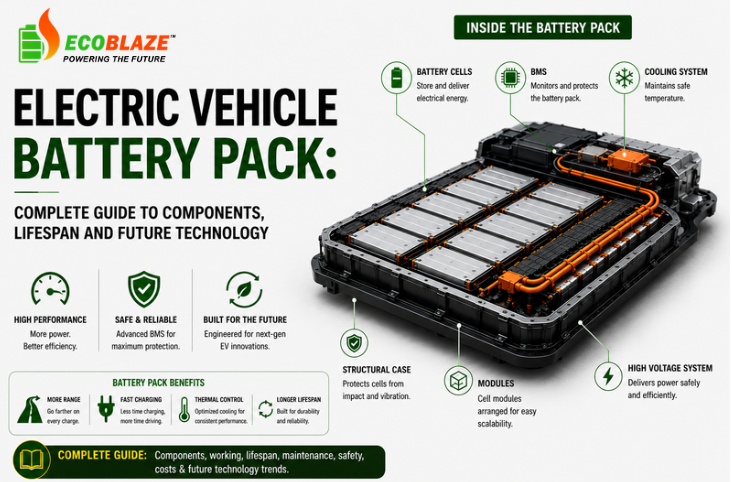
An electric vehicle battery pack is a collection of battery cells, modules, cooling systems, and management electronics designed to store and deliver electrical energy to power electric vehicles.


What Is an Electric Vehicle Battery Pack?

This combines hundreds or thousands of individual cells into one integrated energy system.

The pack includes:

  • Battery cells
  • Battery module
  • Battery Management System (BMS)
  • Cooling systems
  • Sensors
  • Protective casing
  • Electrical connectors

Together, these components create an EV battery pack that is capable of storing and delivering power efficiently.

Unlike traditional fuel tanks, a vehicle battery pack stores energy chemically.


How Does an Electric Vehicle Battery Pack Work?

The vehicle battery pack works by moving lithium ions between electrodes.

During discharge:

Battery cells release energy → Motor receives power → Vehicle moves

During charging:

External electricity restores stored energy.

Modern ev batteries also use regenerative braking, recovering energy while slowing down.


Components of an Electric Vehicle Battery Pack

Understanding pack construction improves buying decisions.

1. Battery Cells

Battery cells are the smallest units.

Common types:

  • Cylindrical cells
  • Pouch cells
  • Prismatic cells

Multiple battery cells form modules.


2. Battery Module

A battery module groups several cells together.

Modules improve:

✔ Maintenance
✔ Thermal management
✔ Voltage balancing


3. Battery Management System (BMS)

The BMS controls:

  • Temperature
  • Charging
  • Voltage
  • Cell balancing

Without BMS, batteries degrade faster.


4. Cooling Systems

Cooling prevents:

  • Overheating
  • Reduced cycle life
  • Thermal runaway

Proper cooling improves high-performance operation.


Types of Electric Vehicle Battery Pack Chemistry

Lithium-Ion Batteries

Most EVs use lithium-ion batteries because of the following:

✔ Higher energy density
✔ Faster charging
✔ Better lifespan

This makes Electric Vehicle Lithium Ion Battery technology dominant globally.


Lithium Iron Phosphate (LFP Cells)

LFP cells provide:

  • Longer cycle life
  • Better safety
  • Lower cost

Common in:

  • Electric scooters
  • E-rickshaws
  • Commercial EVs

Solid-State Battery

A solid-state battery may become the future because it offers the following:

✔ Higher energy density
✔ Improved safety
✔ Longer lifespan


Lead Acid Batteries

Traditional lead-acid systems remain cheaper but have the following:

  • Lower efficiency
  • Shorter lifespan
  • Higher maintenance

Why Electric Vehicle Battery Pack Matters

The electric-vehicle battery pack directly impacts:

Driving Range

Larger packs increase:

  • Range of electric vehicles
  • Performance

Charging Speed

Modern packs support:

  • Fast charging
  • Reduced downtime

Vehicle Cost

Battery packs contribute the following:

30–40% of total EV cost

Material prices affect the following:

  • Lithium
  • Nickel
  • Cobalt

Thus, material cost strongly influences battery prices.


Electric Vehicle Battery Pack Lifespan

Most modern battery packs last

8–20 years

Typical lifespan:

1200–5000 cycles

Factors affecting lifespan:

✔ Temperature
✔ Charging behavior
✔ Usage pattern
✔ Maintenance

Long cycle life reduces ownership costs.


EV Battery Maintenance Tips for Longer Life

Following proper EV battery maintenance tips can help extend the battery’s lifespan.

Best practices:

✔ Keep charge between 20–80%
✔ Avoid excessive fast charging
✔ Prevent overheating
✔ Use recommended chargers
✔ Store at moderate temperature


Battery Capacity Explained

Capacity measured in:

  • Ah (Amp hours)
  • kWh (Kilowatt hours)

Typical capacities:

  • Electric scooters: 48V–72V
  • Passenger EVs: 40–100+ kWh

Larger electric vehicle battery pack means

  • Longer range
  • More weight
  • Higher cost

Electric Vehicle Battery Pack and Charging Technology

Modern EVs use AC Charging

Slower charging

Best for: Home charging


DC Fast Charging

Provides: Faster charging

Useful for: Long-distance travel


Battery Recycling & Sustainability

Battery recycling recovers:

  • Lithium
  • Nickel
  • Cobalt
  • Valuable materials

Recycling reduces:

✔ Mining demand
✔ Environmental impact

Future energy storage systems will increasingly rely on recycled materials.


Future of Electric Vehicle Battery Pack Technology

The future includes:

Solid-state batteries

Improved:

  • Energy density
  • Safety

Sodium-ion batteries

Potential benefits:

  • Lower cost
  • Reduced rare material dependence

AI-based BMS

Smarter systems improve the following:

  • Performance
  • Longevity

EV Growth in India

Demand continues growing for:

Indian manufacturers increasingly develop:


Electric Vehicle Battery Pack Buying Checklist

Before buying:

Check:

✔ Voltage
✔ Capacity
✔ Battery chemistry
✔ Warranty
✔ BMS quality
✔ Cooling technology
✔ Cycle life


Conclusion

The electric vehicle battery pack is more than just an energy source—it determines range, charging speed, safety, and long-term ownership cost.

As EV technology evolves, improved energy density, solid-state battery innovation, smarter BMS systems, and sustainable recycling will redefine transportation globally.

Investing in quality battery packs means better performance, reduced maintenance, and longer lifespan.


People Also Ask and FAQs

  1. What is an electric vehicle battery pack?
    Battery cells and supporting systems used to store and deliver power for EV operation.
  2. How long does a vehicle battery pack last?
    Most modern battery packs last between 8 and 20 years depending on maintenance and charging habits.
  3. Which battery chemistry is best for EVs?
    Lithium-ion batteries dominate because of higher energy density and longer cycle life.
  4. Can EV battery packs be recycled?
    Yes. Valuable materials including lithium and cobalt can be recovered.
  5. What affects EV battery lifespan?
    The factors include temperature, charging behavior, battery chemistry, and maintenance.
  6. How many cells are in an battery pack?
    EV packs may contain hundreds or thousands of individual cells.
  7. What is BMS in EV batteries?
    The Battery Management System controls charging, temperature, and safety.
  8. Which EV battery lasts longest?
    LFP batteries generally provide longer cycle life.
  9. Are lithium batteries better than lead acid?
    Yes. Lithium batteries offer better lifespan, charging, and efficiency.
  10. What reduces battery degradation?
    Maintaining moderate temperatures and avoiding extreme charging.

Electric Vehicle Lithium Ion Battery: Everything You Need to Know

Electric mobility is reshaping transportation worldwide. From electric scooters to commercial EVs and passenger cars, batteries have become the heart of modern vehicles. Among all technologies available today, the Electric Vehicle Lithium Ion Battery remains the dominant choice because of its high energy density, fast charging capability, and longer lifespan.

An electric vehicle lithium-ion battery stores and supplies the electrical energy needed to power motors in electric vehicles. Compared with older technologies, modern lithium ion batteries deliver better performance, improved charging cycles, and higher efficiency.

As EV adoption grows, understanding Electric Vehicle Lithium Ion Battery technology becomes essential for businesses, fleet operators, and everyday users.

This guide covers:

✔ EV battery types
✔ Battery pack components
✔ Lifespan and maintenance
✔ Battery recycling
✔ Future battery technology
✔ Buying considerations


What is an Electric Vehicle Lithium Ion Battery?

An Electric Vehicle Lithium Ion Battery is a rechargeable energy storage system designed specifically to power EV motors.

Unlike traditional fuel systems, these batteries store electrical energy chemically and release it during operation.

Main functions include:

  • Energy storage
  • Power distribution
  • Fast charging support
  • Regenerative braking support
  • Long-term efficiency

The Electric Vehicle Lithium-Ion Battery is widely used because of the following:

  • High power-to-weight ratio
  • Better energy density
  • Long lifespan
  • Lower maintenance

How Does an Electric Vehicle’s Lithium-Ion Battery Work?

A battery operates through the movement of lithium ions between:

  • Cathode
  • Anode
  • Electrolyte
  • Separator

During discharge:

Lithium ions generate electricity and power the vehicle.

During charging:

The process reverses and energy is stored again.

This cycle enables repeated use over thousands of charging sessions.


Main Types of Electric Vehicle Lithium-Ion Batteries

Different battery chemistries affect performance.

1. Lithium Iron Phosphate (LFP)

Features:

✔ Longer lifespan
✔ Better safety
✔ Thermal stability
✔ Lower cost

Common in:

  • E-rickshaws
  • Electric scooters
  • Standard EVs

2. Nickel Manganese Cobalt (NMC)

Benefits:

✔ High energy density
✔ Longer range
✔ Lightweight design

Often used in:

  • Premium EVs
  • High-performance vehicles

3. Lithium Titanate (LTO)

Advantages:

✔ Extremely fast charging
✔ Long cycle life
✔ High safety


Components of Electric Vehicle Battery Pack

Every electric vehicle battery pack includes several critical parts.

Battery Cells

Individual battery cells store energy.

Common formats:

  • Cylindrical cells
  • Prismatic cells
  • Pouch cells

Battery Modules

Multiple cells form modules.

Several modules combine into one battery pack.

Read more about: Lithium Ebike Battery


Battery Management System (BMS)

The BMS controls:

  • Temperature
  • Voltage balance
  • Overcharging prevention
  • Safety monitoring

Cooling Systems

Thermal management prevents the following:

  • Overheating
  • Battery degradation
  • Performance loss

Battery Capacity & Voltage in EVs

Battery sizes vary by vehicle.

Examples:

  • Electric bikes: 36V–72V
  • Electric scooters: 48V–72V
  • Passenger EVs: 50–100+ kWh

Battery capacity directly impacts:

  • Driving range
  • Charging time
  • Performance

Benefits of Electric Vehicle Lithium-Ion Batteries

Better Energy Density

Higher energy storage allows the following:

  • Longer driving range
  • Lightweight vehicles

Faster Charging

Most modern EV batteries support the following:

  • Rapid charging
  • Reduced downtime

Longer Lifespan

Many Electric Vehicle Lithium-Ion Battery systems last:

  • 8–20 years
  • 1200–5000 cycles

Improved Efficiency

Modern ev batteries deliver the following:

  • Stable performance
  • Better power output

EV Battery Maintenance Tips

Following proper EV battery maintenance tips can increase the battery’s lifespan.

Recommended practices:

✔ Avoid frequent 0–100% charging
✔ Maintain 20–80% charge level
✔ Prevent overheating
✔ Use original chargers
✔ Store batteries in moderate temperatures

These steps improve battery health significantly.

Read More: Electric Bike Lithium Battery


Battery Recycling & Sustainability

As EV adoption increases, battery recycling becomes important.

Recycling helps recover:

  • Lithium
  • Nickel
  • Cobalt
  • Other valuable materials

Recovered materials reduce:

  • Mining demand
  • Environmental impact

Research suggests recycled batteries may supply significant future battery material demand.


Environmental Impact of EV Batteries

The transition toward EVs reduces fuel dependence but creates demand for battery materials.

Challenges include:

  • Lithium mining
  • Resource extraction
  • Water usage

Future technologies focus on:

  • Sustainable mining
  • Recycling
  • Alternative chemistries

Future of Electric Vehicle Lithium Ion Battery Technology

The future includes:

Solid-state batteries

Expected benefits:

  • Higher energy density
  • Better safety

Sodium-ion batteries

Advantages:

  • Reduced dependence on rare minerals

Improved recycling systems

Advanced recovery methods will improve sustainability.


Growing Demand for EV Batteries in India

Demand is increasing for:

Growth drivers:

  • Rising fuel prices
  • Government subsidies
  • Sustainable transportation goals

Role of Lithium Battery Manufacturers

Every major:

is investing in:

✔ Better battery chemistry
✔ Advanced BMS technology
✔ Faster charging systems


Real-World Example

Fleet operators switching to Electric Vehicle Lithium Ion Battery systems often report:

  • Lower maintenance cost
  • Better mileage
  • Longer battery lifespan
  • Reduced downtime

This demonstrates why lithium technology dominates EV markets.


Conclusion

The Electric Vehicle Lithium Ion Battery has become the foundation of modern electric transportation. Its superior energy density, fast charging capability, long lifespan, and efficiency make it the preferred solution across EV segments.

As battery technology evolves through improved energy storage, recycling systems, and new chemistry innovations, future electric vehicles will become safer, cheaper, and more sustainable. Choosing quality battery systems today ensures better performance and long-term reliability.


People Also Ask and FAQs

  1. What is an electric vehicle lithium ion battery?
    A rechargeable battery system that stores and delivers energy to power EV motors.
  2. How long do EV lithium ion batteries last?
    Most last between 8 and 20 years depending on charging and usage.
  3. Which EV battery chemistry is best?
    LFP is safer and durable, while NMC offers higher energy density.
  4. Are EV batteries recyclable?
    Yes. Valuable materials including lithium and nickel can be recovered.
  5. What affects EV battery lifespan?
    Temperature, charging habits, and battery management systems.
  6. Why are lithium ion batteries used in EVs?
    They provide higher energy density and longer lifespan.
  7. Can EV batteries be recycled?
    Yes. Recycling recovers critical battery materials.
  8. Do EV batteries require maintenance?
    Minimal maintenance compared to conventional systems.
  9. How fast can EV batteries charge?
    Fast charging depends on battery type and charger capacity.
  10. What is battery degradation?
    Gradual reduction in battery capacity over time.

Lithium Ebike Battery: Everything You Need to Know Before Buying

Electric bikes are changing urban transportation. Rising fuel prices, increasing environmental awareness, and demand for affordable commuting have made e-bikes more popular than ever. At the center of every electric bike is one component that determines performance — the Lithium Ebike Battery.

A high-quality Lithium Ebike Battery affects:

  • Riding range
  • Charging speed
  • Battery lifespan
  • Vehicle performance
  • Energy efficiency
  • Maintenance costs

Modern Lithium Ebike Battery systems outperform traditional lead acid battery technology because they are lighter, faster charging, and more durable.

This guide explains everything about selecting the right Lithium Ebike Battery, including battery types, voltage, capacity, maintenance, and future EV trends.


What is a Lithium Ebike Battery?

A Lithium Ebike Battery is a rechargeable lithium ion battery designed to power electric bicycles and electric bikes.

It stores electrical energy and supplies power to the motor during riding.

Main benefits include:

High energy density
Faster charging
Lightweight construction
Longer lifespan
Better riding range
Lower maintenance

These advantages explain why the Lithium Ebike Battery has become standard in electric mobility.


Why Lithium Ebike Battery Is Better Than Lead Acid Battery

Traditional lead acid battery systems are heavier and less efficient.

A modern Lithium Ebike Battery offers:

FeatureLithium BatteryLead Acid Battery
Lifespan5–8 years1–3 years
WeightLightweightHeavy
ChargingFastSlow
MaintenanceLowHigh
EfficiencyHighModerate

Longer Battery Life

Most Lithium Ebike Battery systems support the following:

  • 2000–5000 charging cycles
  • 5–8 years average lifespan

This significantly reduces replacement costs.


Faster Charging

Lithium batteries typically charge within the following timeframes:

  • 3–5 hours

Fast charging means less downtime and more usability.


Better Riding Range

Higher energy density allows the following:

  • Longer travel distance
  • Better performance
  • Improved efficiency

Types of Lithium Ebike Battery

Different battery chemistries affect performance.

1. Lithium Iron Phosphate (LFP)

Advantages:

  • Longer lifespan
  • Better safety
  • Thermal stability

2. Nickel Manganese Cobalt (NMC)

Benefits:

  • Higher energy density
  • Better range
  • Lightweight performance

3. Advanced Lithium Ion Battery Systems

Modern systems support:

  • Fast charging
  • Improved safety
  • Higher efficiency

Components of Lithium Ebike Battery

A Lithium Ebike Battery generally contains the following:

Battery Cells

Common types:

  • Cylindrical cells
  • Pouch cells
  • Prismatic cells

Battery Management System (BMS)

The BMS controls:

  • Voltage balance
  • Overcharge protection
  • Temperature monitoring
  • Safety systems

Thermal Management

Helps:

  • Prevent overheating
  • Increase lifespan
  • Improve charging safety

Battery Housing

Protects against:

  • Water
  • Dust
  • Shock
  • Heat

Many battery packs feature IP67 protection.


Voltage & Capacity for Lithium Ebike Battery

Common voltage systems:

  • 36V
  • 48V
  • 52V
  • 60V
  • 72V

Capacity often ranges.

  • 10Ah
  • 20Ah
  • 30Ah
  • 40Ah

The correct capacity depends on:

  • Riding distance
  • Terrain
  • Motor size
  • Daily usage

How to Choose the Best Lithium Ebike Battery

Choosing the right Lithium Ebike Battery requires evaluating the following:

Battery Capacity

Higher capacity improves range but increases weight.


Riding Requirements

Consider:

  • City commuting
  • Long-distance riding
  • Hills and terrain

Battery Certifications

Look for:

  • BIS certification
  • Safety testing
  • Thermal protection

Warranty

A trusted Lithium Battery Supplier should provide the following:

  • Warranty support
  • Technical assistance
  • After-sales service

EV Battery Maintenance Tips

Following proper ev battery maintenance tips extends battery life.

Recommended practices:

  • Avoid complete discharge
  • Prevent overcharging
  • Use original chargers
  • Store away from extreme temperatures
  • Keep batteries dry

Good maintenance significantly increases lifespan.


Benefits of Lithium Ebike Battery for Daily Riders

Using a Lithium Ebike Battery provides the following benefits for riders:

  • Save money: Lower fuel and maintenance expenses.
  • Improve efficiency: Better charging and discharging cycles.
  • Reduce emissions: Supports cleaner transportation.
  • Increase convenience: Fast charging and lightweight design improve daily commuting.

Role of Battery Pack Technology in EV Growth

Every modern battery pack for electric vehicles includes:

  • Smart battery systems
  • Efficient thermal management
  • High energy density

Advanced electric vehicle battery pack technology is transforming EV performance globally.


Future of Lithium Battery Technology

The future of mobility depends on innovation.

Every major:

is investing in:

  • Fast charging systems
  • Better battery chemistry
  • Smart BMS technology
  • Lightweight energy solutions

Growing Demand for EV Batteries in India

Demand continues increasing for:

This growth is driven by:

  • Rising fuel prices
  • EV adoption
  • Government incentives

Real-World Example

An e-bike delivery fleet replaced traditional batteries with lithium systems.

Results:

✔ Faster charging
✔ Better riding range
✔ Reduced maintenance cost
✔ Longer battery lifespan

This demonstrates why Lithium Ebike Battery technology dominates modern EV markets.

Read more about: Electric Bike Lithium Battery


Conclusion

Choosing the right Lithium Ebike Battery is essential for achieving longer range, faster charging, better efficiency, and lower operating expenses. Compared with traditional lead acid battery systems, lithium batteries deliver superior performance, reduced maintenance, and improved lifespan.

As electric mobility continues growing, advanced lithium ion batteries will define the future of transportation. Investing in high-quality battery systems ensures long-term reliability and better EV performance.


People Also Ask and FAQs

  1. What is a lithium e-bike battery?
    A rechargeable lithium ion battery used to power electric bikes efficiently.
  2. How long does a lithium e-bike battery last?
    Most last 5–8 years depending on usage and charging habits.
  3. Which battery is better for e-bikes: lead acid or lithium?
    Lithium batteries offer better lifespan, efficiency, and charging speed.
  4. What voltage is common for electric bike batteries?
    36V, 48V, 52V, and 72V systems are commonly used.
  5. How long does charging take?
    Typically 3–5 hours depending on capacity.
  6. Can lithium batteries improve e-bike range?
    Yes. Higher energy density improves riding distance significantly.
  7. Are lithium ebike batteries safe?
    Yes, modern batteries include BMS and thermal protection.
  8. Do lithium batteries require maintenance?
    Compared to lead-acid batteries, this type requires very little maintenance.
  9. What affects battery lifespan?
    Temperature, charging habits, and usage patterns.
  10. Why are lithium batteries becoming more popular?
    Because they provide rapid charging, lightweight performance, and longer lifespan.

Electric Bike Lithium Battery: Everything You Need to Know

Electric bikes are transforming the future of mobility in India. Rising fuel costs, environmental concerns, and demand for affordable commuting have increased the popularity of electric bikes. However, one component determines the overall performance of an EV bike more than anything else — the Electric Bike Lithium Battery.

A high-quality Electric Bike Lithium Battery directly affects speed, range, charging time, efficiency, and lifespan. Modern lithium-ion battery systems are replacing traditional batteries because they provide better performance, lightweight design, and longer operational life.

Whether you own an electric bike or plan to buy one, understanding battery technology is essential. In this guide, you’ll learn everything about Electric Bike Lithium Battery, including battery types, charging systems, lifespan, safety, maintenance, and buying considerations.


What is an Electric Bike Lithium Battery?

An Electric Bike Lithium Battery is a rechargeable battery system designed to power electric two-wheelers using lithium ion technology.

These batteries store electrical energy and supply power to the motor.

Main advantages include:

  • High energy density
  • Fast charging capability
  • Longer lifespan
  • Lightweight design
  • Better performance
  • Reduced maintenance

These advantages make lithium batteries the preferred option for electric bikes.


Why Electric Bike Lithium Battery is Better Than Traditional Batteries

Traditional lead-acid batteries are becoming outdated.

An advanced Electric Bike Lithium Battery offers:

Longer Lifespan

Lithium batteries typically provide the following:

  • 2000–5000 charging cycles
  • 5–8 years lifespan

This reduces replacement costs significantly.


Faster Charging

Modern electric bike batteries support the following:

  • Fast charging
  • Reduced downtime
  • Better daily usability

Many systems charge within:

  • 3–5 hours

Lightweight Design

A lighter battery improves the following:

  • Bike acceleration
  • Efficiency
  • Riding performance
  • Battery range

Better Energy Efficiency

Lithium batteries support the following:

  • Stable charging and discharging
  • Improved power delivery
  • Reduced energy loss

Types of Electric Bike Lithium Batteries

Understanding battery chemistry helps buyers choose better systems.

1. Lithium Iron Phosphate (LFP)

Benefits include:

  • Better safety
  • Longer lifespan
  • Thermal stability
  • Affordable operation

LFP batteries are popular in EV applications.


2. Nickel Manganese Cobalt (NMC)

Advantages:

  • High energy density
  • Longer riding range
  • Better performance

Often used in premium electric bikes.


3. Advanced Lithium-Ion Batteries

These systems offer:

  • Improved charging speed
  • Lightweight structure
  • Better efficiency

Components of an Electric Bike Lithium Battery

A modern Electric Bike Lithium Battery contains:

Battery Cells

Common battery cell types:

  • Cylindrical cells
  • Pouch cells
  • Prismatic cells

These store electrical energy.


Battery Management System (BMS)

The BMS controls:

  • Voltage monitoring
  • Temperature management
  • Overcharge protection
  • Battery balancing

This improves safety and battery life.


Thermal Protection System

Thermal systems help:

  • Prevent overheating
  • Improve battery lifespan
  • Increase charging safety

Battery Housing

Protective housing prevents damage from:

  • Dust
  • Water
  • Impact
  • Heat

Many batteries include IP67-rated protection.


Electric Bike Battery Voltage & Capacity

Most electric bikes use the following:

  • 48V battery systems
  • 60V battery systems
  • 72V battery systems

Battery capacity generally ranges between the following:

  • 20Ah
  • 30Ah
  • 40Ah
  • 60Ah

The right battery depends on:

  • Riding distance
  • Vehicle weight
  • Daily usage

Benefits of Electric Bike Lithium Battery

Longer Riding Range

A modern Electric Bike Lithium Battery provides:

  • Better energy density
  • Extended driving range
  • Improved efficiency

Reduced Operating Costs

Lithium batteries reduce the following:

  • Maintenance expenses
  • Replacement frequency
  • Charging losses

Better Performance

Electric bikes become the following:

  • Faster
  • More efficient
  • More reliable

Eco-Friendly Transportation

Lithium batteries support the following:

  • Reduced emissions
  • Sustainable transportation
  • Renewable energy goals

Difference Between Lithium & Lead-Acid Batteries

FeatureLithium BatteryLead-Acid Battery
Lifespan5–8 Years1–3 Years
WeightLightweightHeavy
ChargingFastSlow
MaintenanceLowHigh
EfficiencyHighModerate

This study explains why EV owners prefer Electric Bike Lithium Battery systems.


EV Battery Maintenance Tips

Following proper EV battery maintenance tips can improve battery performance.

Important recommendations:

  • Avoid deep discharge frequently
  • Prevent overcharging
  • Use compatible chargers
  • Keep batteries away from heat
  • Store in dry conditions

Proper maintenance extends battery lifespan significantly.


How to Choose the Best Electric Bike Lithium Battery

Before buying, consider:

Battery Capacity

Choose based on:

  • Daily travel distance
  • Rider usage
  • Performance requirements

Battery Safety

Look for:

  • Smart BMS
  • Thermal protection
  • Waterproof design

Certifications

Always verify:

  • BIS certification
  • Safety standards
  • Quality testing

Warranty Support

A trusted Lithium Battery Supplier should provide the following:

  • Long warranty
  • Technical support
  • Service assistance

Growing Demand for Electric Mobility

India’s EV market continues expanding because of:

  • Rising fuel prices
  • Government subsidies
  • Demand for sustainable transport

This increases demand for:


Role of Battery Pack Technology

Every modern Battery Pack for Electric Vehicle requires:

  • Smart battery systems
  • Efficient thermal management
  • Long cycle life
  • High safety standards

An advanced electric vehicle battery pack improves performance significantly.


Future of Lithium Battery Technology in India

Every major Lithium Battery Company in India and Lithium Battery Manufacturer in India is investing in the following:

  • Fast charging technology
  • Smart BMS systems
  • Lightweight batteries
  • Advanced energy storage solutions

This innovation will define the future of electric mobility.

Read blog: Lithium Battery for E Rickshaw


Real-World Example

An electric bike fleet switched from conventional batteries to lithium ion systems.

Results:

  • Faster charging
  • Better daily range
  • Lower maintenance cost
  • Improved efficiency

This study demonstrates why Electric Bike Lithium Battery technology dominates modern EV markets.


Conclusion

Choosing the right Electric Bike Lithium Battery is critical for achieving better performance, longer range, improved efficiency, and reduced maintenance expenses. Lithium batteries outperform traditional options because they offer fast charging, lightweight design, longer lifespan, and better safety.

As India accelerates toward electric mobility, advanced battery technology will continue powering the future of transportation. Selecting a reliable battery with smart BMS, thermal protection, and quality certifications ensures long-term performance and value.


People Also Ask and FAQs

  1. Which battery is best for electric bikes?
    Lithium ion batteries are considered best because of long lifespan and fast charging.
  2. How long does an electric bike lithium battery last?
    Most batteries last between 5–8 years depending on usage.
  3. What voltage is used in electric bike batteries?
    Most electric bikes use 48V, 60V, or 72V systems.
  4. Are lithium batteries better than lead-acid batteries?
    Yes, they provide better efficiency, lower weight, and faster charging.
  5. How long does electric bike battery charging take?
    Usually around 3–5 hours depending on battery capacity.
  6. Can lithium batteries improve electric bike range?
    Yes, they offer higher energy density and better efficiency.
  7. Are electric bike lithium batteries safe?
    Yes, modern systems include BMS and thermal protection.
  8. Do lithium batteries need maintenance?
    Very little maintenance compared to lead-acid batteries.
  9. What affects battery lifespan?
    Temperature, charging habits, and usage patterns impact lifespan.
  10. Why are lithium batteries becoming popular?
    They offer rapid charging, low maintenance, and better performance.

Introduction: E Rickshaw Lithium Battery: Everything You Need to Know

India’s electric mobility market is growing rapidly, and e rickshaws have become one of the most affordable and widely used commercial electric vehicles in the country. As fuel prices continue to rise, many drivers and fleet operators are now switching to advanced E Rickshaw Lithium Battery systems for better performance, lower maintenance, and improved driving range.

Traditional lead-acid batteries are slowly being replaced because they are heavier, slower to charge, and require regular maintenance. Modern lithium ion battery systems offer faster charging, longer lifespan, lightweight performance, and higher energy efficiency. This makes an E-Rickshaw Lithium Battery the preferred choice for commercial EV transportation.

Today, battery technology plays a major role in determining the performance, profitability, and reliability of electric rickshaws. Choosing the right battery system can significantly reduce operating costs while improving daily vehicle usage.

In this detailed guide, we will explain everything about choosing the best E-Rickshaw Lithium Battery, including battery types, charging systems, maintenance tips, safety features, voltage configurations, and future EV battery trends in India.


What is an E Rickshaw Lithium Battery?

An E-Rickshaw Lithium Battery is a rechargeable lithium ion energy storage system specifically designed for electric rickshaws and commercial three-wheelers.

These batteries:

  • Store electrical energy
  • Deliver power to EV motors
  • Support fast charging
  • Improve vehicle efficiency
  • Provide longer driving range

Modern lithium batteries are replacing traditional lead-acid batteries because they offer superior performance and durability.


Why Lithium Batteries Are Better for E-Rickshaws

Lithium-ion batteries provide multiple advantages for commercial EV operations.

Longer Lifespan

A quality E-Rickshaw Lithium Battery can last

  • 5–8 years
  • 2000–4000 charging cycles

This makes lithium batteries more cost-effective over time.


Fast Charging Support

Fast charging helps drivers reduce downtime.

Lithium batteries typically charge within the following timeframes:

  • 3–5 hours

compared to much longer charging times for lead-acid batteries.


Lightweight Performance

Lithium batteries are much lighter than traditional batteries.

Benefits include:

  • Better speed
  • Improved efficiency
  • Higher payload capacity
  • Longer vehicle range

Low Maintenance

Unlike lead-acid systems, lithium batteries

  • Require very little maintenance
  • Do not need water refilling
  • Deliver stable charging performance

Main Components of an E-Rickshaw Lithium Battery

Understanding battery components helps buyers choose better EV battery systems.

Lithium Ion Cells

Battery cells store and deliver energy.

Common cell types:

  • Cylindrical cells
  • Prismatic cells
  • Pouch cells

Battery Management System (BMS)

The BMS is responsible for:

  • Voltage monitoring
  • Temperature control
  • Overcharge protection
  • Battery balancing
  • Short-circuit safety

A smart BMS improves battery safety and lifespan.


Thermal Management System

Thermal systems help control heat during charging and discharging.

These systems include:

  • Cooling channels
  • Heat sensors
  • Ventilation systems

Protective Battery Housing

Modern battery packs feature the following:

  • Waterproof enclosures
  • Dust protection
  • Shock-resistant casing

Most systems now include IP67-rated safety protection.


Voltage & Capacity of E Rickshaw Lithium Battery

Most electric rickshaws use the following:

  • 48V systems
  • 60V systems
  • 72V systems

Battery capacities generally range from the following:

  • 80Ah
  • 100Ah
  • 150Ah
  • 200Ah

The ideal battery depends on:

  • Vehicle type
  • Passenger load
  • Daily usage
  • Driving distance

Advantages of E Rickshaw Lithium Battery

Better Driving Range

A modern E Rickshaw Lithium Battery offers high energy density, allowing vehicles to travel longer distances on a single charge.


Lower Operating Costs

Lithium batteries reduce the following:

  • Maintenance costs
  • Battery replacement expenses
  • Charging losses

This increases profitability for commercial EV operators.


Efficient Charging & Discharging

Lithium-ion systems support the following:

  • Stable charging
  • Better power output
  • Efficient charging and discharging cycles

Eco-Friendly Mobility

Lithium batteries support the following:

  • Clean transportation
  • Renewable energy goals
  • Reduced carbon emissions

Difference Between Lithium and Lead-Acid Batteries

FeatureLithium BatteryLead-Acid Battery
Lifespan5–8 Years1–3 Years
Charging SpeedFastSlow
WeightLightweightHeavy
MaintenanceLowHigh
EfficiencyHighModerate

This trend is why more drivers now prefer Lithium Battery for E Rickshaw systems.


EV Battery Maintenance Tips

Following proper EV battery maintenance tips can improve battery life and charging efficiency.

Important Tips:

  • Avoid complete discharge frequently
  • Use compatible chargers
  • Prevent overheating
  • Avoid overcharging
  • Store batteries in dry places

Proper maintenance significantly increases battery lifespan.


How to Choose the Best E Rickshaw Lithium Battery

Choosing the right battery system is extremely important for commercial performance.

Battery Capacity

Choose battery capacity based on:

  • Daily travel distance
  • Passenger load
  • Commercial usage hours

Battery Safety Features

Look for:

  • Smart BMS systems
  • Thermal protection
  • Waterproof battery housing

Certifications

Always select batteries with:

  • BIS certification
  • ISO standards
  • IP67-rated protection

Warranty & Service Support

A reliable Lithium Battery Supplier should provide the following:

  • Long warranty
  • Technical assistance
  • Battery replacement support

Role of Electric Vehicle Battery Pack Technology

Modern electric vehicle battery pack systems are designed for:

  • Better safety
  • Faster charging
  • Lightweight performance
  • Longer cycle life

An advanced battery pack for electric vehicles significantly improves EV efficiency.


Growing Demand for Electric Three-Wheelers

India’s EV industry is expanding rapidly due to:

  • Rising fuel costs
  • Government subsidies
  • Affordable EV transportation
  • Demand for sustainable mobility

This trend is increasing the demand for the following:


Future of Lithium Battery Technology in India

Every major Lithium Battery Company in India and Lithium Battery Manufacturer in India is investing heavily in the following:

  • Advanced lithium ion technology
  • Smart BMS systems
  • Energy storage solutions
  • Fast charging systems

The future of electric transportation depends heavily on battery innovation and energy efficiency.


Real-World Example

An e rickshaw fleet operator replaced lead-acid batteries with lithium ion battery systems.

Results after one year:

  • Faster charging time
  • 40% lower maintenance cost
  • Improved daily driving range
  • Better vehicle performance

This shows why lithium technology is becoming the future of electric three-wheelers.


Conclusion

Choosing the right E Rickshaw Lithium Battery is essential for achieving better performance, longer lifespan, lower operating costs, and improved commercial efficiency. Compared to traditional lead-acid batteries, lithium-ion battery systems offer major advantages including fast charging, lightweight design, high energy density, and low maintenance.

As India continues moving toward electric mobility, lithium battery systems will become the foundation of modern e rickshaw transportation. By selecting reliable battery systems with advanced safety features, smart BMS technology, and efficient charging systems, businesses and drivers can maximize long-term profitability and performance.


People Also Ask and FAQs

  1. Which battery is best for an e-rickshaw?
    Lithium-ion batteries are considered the best due to fast charging and longer lifespan.
  2. How long does an e-rickshaw lithium battery last?
    Most lithium batteries last between 5 and 8 years, depending on usage.
  3. What voltage is used in e-rickshaw batteries?
    Most e-rickshaws use 48V, 60V, or 72V systems.
  4. Are lithium batteries better than lead-acid batteries?
    Yes, they are lighter, faster charging, and more energy efficient.
  5. How much charging time does a lithium e-rickshaw battery require?
    Charging usually takes around 3–5 hours depending on battery capacity.
  6. Can lithium batteries improve e-rickshaw range?
    Yes, lithium batteries provide better energy density and longer backup.
  7. Are lithium batteries safe for electric rickshaws?
    Yes, modern systems include advanced thermal and safety protection.
  8. Do lithium batteries require maintenance?
    Very little maintenance is required compared to lead-acid batteries.
  9. What affects lithium battery lifespan?
    Charging habits, temperature, and battery quality affect lifespan.
  10. Why are lithium batteries becoming popular in India?
    They offer better efficiency, lower maintenance, and support clean mobility.