Finding a reliable supplier of lithium ion batteries in India is harder than it looks. Resellers, importers, and assemblers flood the market, using the same language as genuine manufacturers. The difference only becomes clear after purchase, when performance doesn’t match the spec sheet, certifications turn out to be missing, or after-sales support disappears.
This guide tells you exactly what to check before you choose a lithium ion battery supplier—whether you’re an OEM, a fleet operator, or a dealer building an EV battery business.
What Is a Lithium Ion Battery Supplier?
A lithium ion battery supplier is a company that provides lithium-ion battery packs to OEMs, dealers, fleet operators, and end users. The term covers a wide spectrum—from vertically integrated manufacturers who design, assemble, and test their packs to pure distributors who source finished products from third-party factories and resell them.
The distinction matters because it directly affects what you get: pricing, customization capability, certification accountability, technical support, and consistency of supply.
Types of lithium ion battery suppliers in India:
- Manufacturers: Design and assemble battery packs in-house, with full control over cell selection, BMS, and pack engineering
- Assemblers: Source cells and BMS from third parties, assemble packs, but don’t control the underlying design
- Distributors/Resellers: Source finished packs from manufacturers and sell under their own brand or the original brand
- Importers: Bring in finished packs from overseas—typically Chinese factories—and sell in India with or without local certification
Each type has a place in the supply chain, but the right choice depends heavily on your application, volume, and quality requirements.
Why Choosing the Right Supplier Matters
A lithium ion battery supplier isn’t just a vendor—they’re a long-term partner in your product’s performance. A poor choice leads to:
- Inconsistent cell quality — performance that varies batch to batch
- BMS failures — protection circuits that fail under real-world stress
- Certification gaps — packs that don’t meet AIS 156 requirements for registered EVs
- No after-sales support — nowhere to turn when a pack fails in the field
- Supply chain instability — sudden price changes or delivery delays that affect your operations
Getting the supplier decision right upfront saves money, reputation, and time.
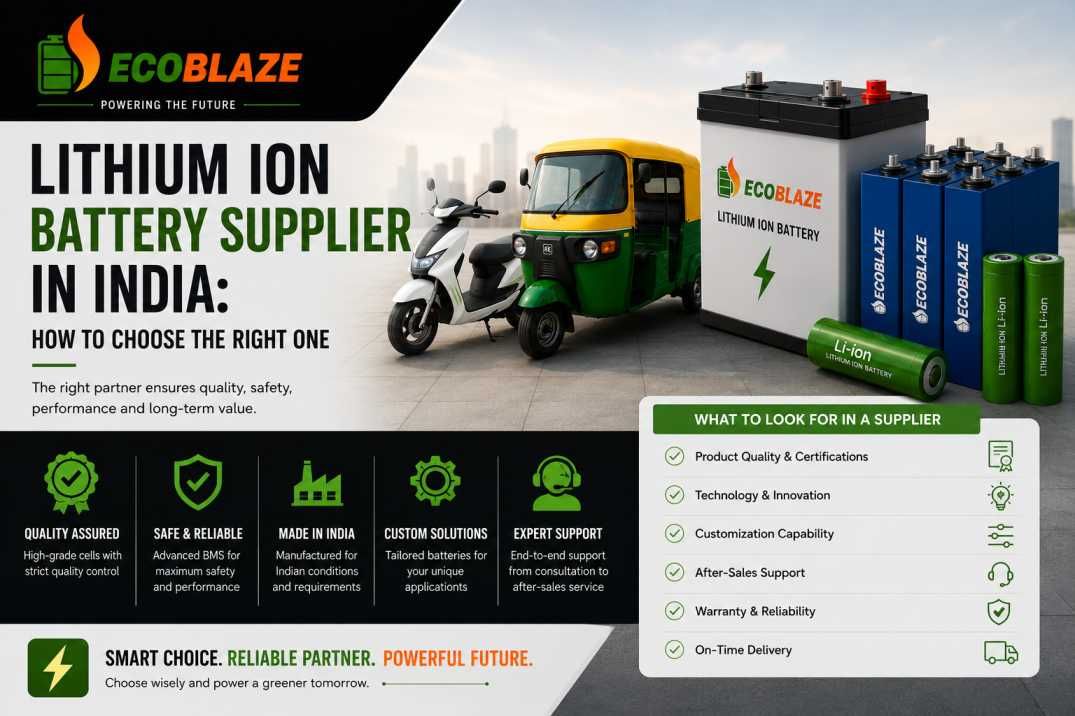
Key Things to Check Before You Buy
1. Manufacturing Capability vs Reseller
The first question to ask any lithium ion battery supplier is simple: do you manufacture or source? A manufacturer can show you a factory, an assembly line, and in-house testing equipment. A reseller can show you a warehouse.
Neither is necessarily wrong for your application—but you need to know which you’re dealing with before you evaluate pricing, lead times, and customization options.
2. AIS 156 Certification
For any lithium ion battery pack used in a registered electric vehicle in India, AIS 156 certification is mandatory. A genuine supplier should be able to provide certification documentation for the specific pack model you’re buying — not just a general brand certificate.
Ask for the certification reference number and verify it matches the pack configuration you’re ordering. Details on what this standard covers are available on the certifications and compliance page.
3. Cell Grade and Source Transparency
Cell quality is the single biggest determinant of long-term pack performance. A trustworthy supplier is transparent about:
- Cell chemistry (NMC or LFP)
- Cell format (cylindrical 21700, 18650, prismatic, pouch)
- Cell grade (A-grade EV cells vs B-grade or ungraded)
- Cell manufacturer or source country
Evasiveness about any of these points is a cause for concern. An A-grade NMC 21700 cylindrical cell pack for two wheeler batteries performs very differently from an ungraded cell pack—even if both are marketed with similar specifications.
4. In-House BMS Design
The Battery Management System is what makes a lithium pack safe and extends its working life. A supplier of lithium ion batteries with in-house BMS design has real control over how the pack behaves under load, what protections are active, and how faults are logged and managed.
Suppliers using off-the-shelf or imported BMS units have limited ability to customize protection thresholds, communication protocols, or IoT features. For commercial fleet applications, a well-engineered battery management system with IoT connectivity is often the deciding factor in supplier selection.
5. IP Rating and Environmental Protection
Any lithium ion battery pack used in Indian road conditions must have proper ingress protection:
- IP65 minimum for two-wheeler packs
- IP67 for three-wheeler and commercial vehicle packs — especially important for monsoon and flood-prone regions
Any company that can’t confirm the IP rating of their pack—or that quotes a rating without test evidence—is a supplier to approach carefully.
6. Cycle Life Data
Cycle life is the most important long-term spec for any EV battery. A reliable lithium ion battery supplier provides cycle life ratings backed by test data—not just marketing claims.
Benchmark targets to look for:
- NMC packs for two-wheelers: 1,000+ cycles
- LFP packs for three-wheelers and commercial vehicles: 2,500+ cycles
For context on how cycle life compares against lead-acid in real commercial use, the lithium vs lead acid e-rickshaw cost breakdown is a useful reference.
7. Warranty Terms
A company confident in their product offers clear, documented warranty terms covering the following:
- Warranty period (months or cycles)
- What’s covered and excluded
- Replacement or repair process
- Who bears transport costs for warranty claims
Vague or verbal warranty commitments — with nothing in writing — are a common issue in the Indian battery market. Get it in writing before you commit.
8. Minimum Order Quantities and Lead Times
For OEMs and fleet operators, supply reliability matters as much as product quality. Understand your supplier’s:
- Minimum order quantities (MOQ)
- Standard lead times for repeat orders
- Stock holding or build-to-order model
- Ability to scale supply as your volumes grow
Manufacturer vs Reseller: Key Differences
| Factor | Manufacturer | Reseller/Distributor |
|---|---|---|
| Customisation | Yes—voltage, capacity, BMS | Limited or none |
| Pricing | Direct factory pricing | Mark-up on wholesale |
| Certification accountability | Full accountability | Depends on source |
| Technical support | In-house engineering team | Dependent on OEM |
| Cell grade control | Direct sourcing | Limited visibility |
| Supply consistency | Controlled production schedule | Dependent on upstream |
| MOQ flexibility | Varies by manufacturer | Often lower MOQs |
For volume OEM and fleet procurement, working directly with a manufacturer as your lithium ion battery supplier delivers better pricing, more customization, and cleaner accountability. For lower volume or trial orders, a distributor may offer easier access with lower MOQs.
Red Flags to Watch Out For
Be aware of these warning signs:
- No AIS 156 documentation — or inability to produce it on request
- Unclear about cell source — “we use good cells” without specifics
- Suspiciously low pricing — usually reflects ungraded cells or missing BMS protections
- No IP rating confirmation — or unverified IP claims
- No physical factory or testing facility — just a distributor operating as a manufacturer
- Generic specs—exactly matching a common imported Chinese pack with no customisation
- No warranty in writing — verbal commitments that disappear post-sale
Questions to Ask Before You Commit
These questions separate reliable suppliers from unreliable ones:
- What is the cell chemistry, format, and grade used in this pack?
- Who manufactures the cells, and can you provide the cell datasheet?
- Is the BMS designed in-house or sourced externally?
- Please provide the AIS 156 certification documents for this specific pack model.
- What is the IP rating and what test standard was used?
- What cycle life testing has been done, and at what depth of discharge?
- What are the warranty terms in writing?
- What is your lead time for repeat orders at [your volume]?
A supplier worth working with will answer all eight questions clearly and in writing.
Lithium Ion Battery Supplier for Different EV Segments
Two-Wheeler OEMs and Dealers
For electric scooters and e-bikes, look for a lithium ion battery supplier offering NMC 21700 packs with an IP65 rating, 1,000+ cycle life, AIS 156 certification, and customizable voltage and capacity. Our guide on electric bike lithium battery options covers what to specify for this segment.
Three-Wheeler and E-Rickshaw Operators
For commercial three-wheelers, the right lithium ion battery supplier offers LFP chemistry at 51.2V/60V/72V, an IP67 rating, a 2,500+ cycle life, and a smart BMS with IoT. The three wheeler batteries page covers the full specification range.
Fleet Operators
Fleet operators need a lithium-ion battery supplier with an IoT-enabled BMS for remote monitoring, a consistent supply for ongoing replacements, and clear warranty terms that work at scale. For broader context on the lithium ion battery companies in India landscape, that guide covers the main players and what differentiates them.
Benefits of Working with a Certified Supplier
Working with the right lithium-ion battery supplier delivers the following:
- Consistent pack performance — same specs batch to batch, not just in the first delivery
- Full certification compliance — AIS 156 documentation that holds up to regulatory scrutiny
- Technical support — access to engineers who understand the pack design, not just the sales team
- Scalable supply — ability to grow order volumes without switching suppliers
- Warranty accountability—written terms that are actually honoured
FAQs: Lithium Ion Battery Supplier
- What should I verify first when choosing a lithium ion battery supplier?
Start with AIS 156 certification documentation for the specific pack you’re buying. Then verify cell grade and chemistry, BMS design capability, IP rating, and cycle life data. A supplier who can’t provide clear answers to these is not ready for serious OEM or fleet procurement. - Is there a difference between a lithium ion battery supplier and a manufacturer?
Yes. A manufacturer designs and assembles packs in-house with direct control over cells, BMS, and testing. A supplier may be a manufacturer, an assembler, or a reseller of another brand’s packs. Knowing what you’re dealing with affects pricing, customization, certification accountability, and after-sales support. - Do I need AIS 156 certification from my battery supplier?
Yes, you need AIS 156 certification if the packs are for use in registered electric vehicles in India. AIS 156 is mandatory and your supplier must be able to provide documentation specific to the pack model you’re purchasing. - Can a lithium-ion battery supplier customize voltage and capacity?
A manufacturer-supplier can typically customize voltage, capacity, BMS features, and form factor within their production capability. Resellers and distributors usually cannot customize—they sell fixed configurations sourced from their upstream manufacturer. - How do I verify a lithium ion battery supplier’s AIS 156 certification is genuine?
Request the certification document, including the certification body name, certificate number, and the specific pack model it covers. Cross-reference with the certifications and compliance standards to confirm the scope matches what you’re buying.
Conclusion
Choosing the right supplier of lithium ion batteries is one of the most consequential decisions in an EV business. The difference between a manufacturer with in-house BMS design, verified cell sourcing, and genuine AIS 156 certification and a reseller with imported packs and verbal warranty commitments shows up in field performance, replacement rates, and customer complaints.
Ask the right questions upfront. Insist on documentation. Verify certification specifics, not just brand claims. And choose a supplier whose technical capability matches what your application actually demands.
If you’re looking for a lithium ion battery supplier for two-wheeler or three-wheeler EV applications, request a quote from Ecoblaze with your voltage, capacity, and volume requirements.